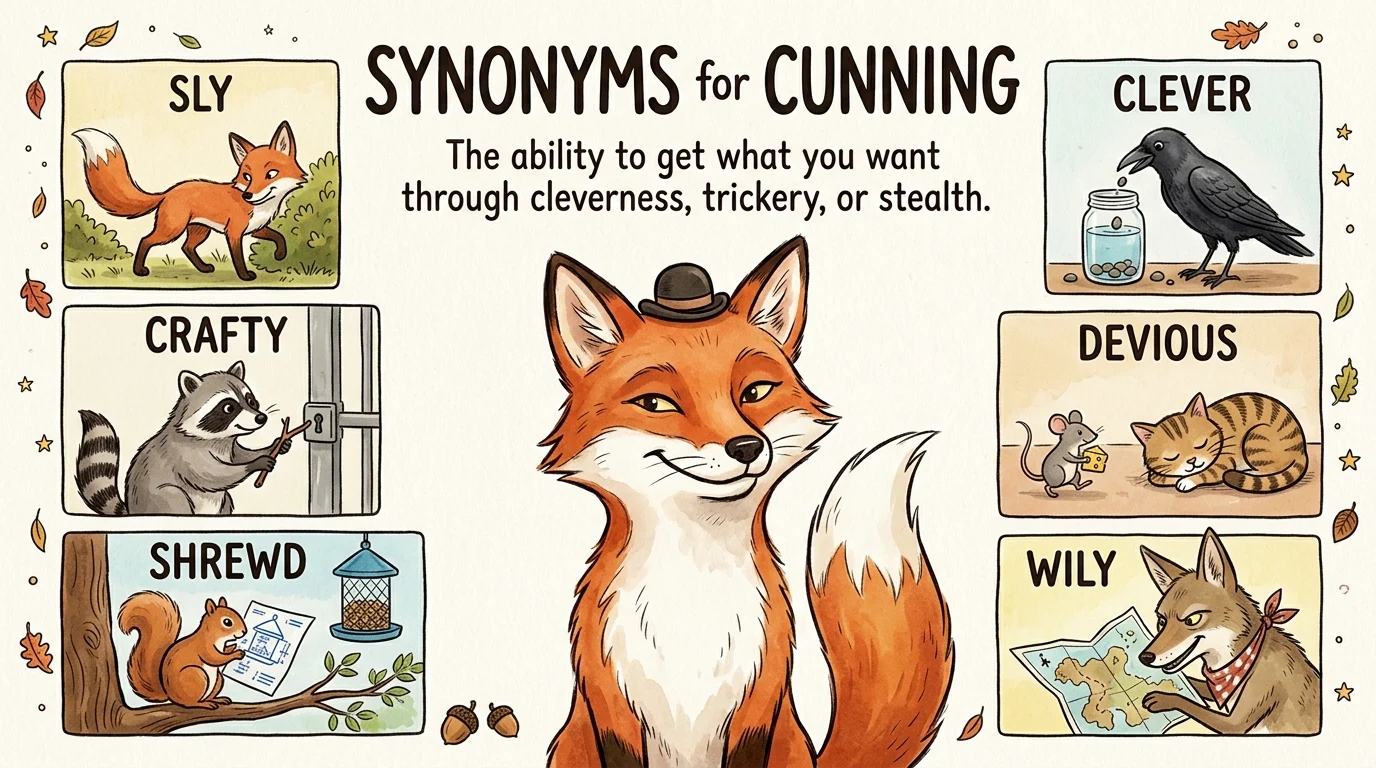
The word cunning describes someone who uses intelligence, cleverness, and careful planning to achieve a goal. It can also suggest dishonesty when a person relies on tricks, secrecy, or manipulation.
For example, a cunning businessman might find a clever way to negotiate a better deal. However, a cunning thief might use deception to avoid getting caught.
The right alternative depends on what you want to express. Words such as crafty, sly, and wily emphasize clever behavior, while astute, shrewd, and ingenious highlight intelligence and good judgment.
This guide covers 50 synonyms for cunning, with simple meanings and natural examples. You will also discover positive and negative alternatives, formal expressions, and useful differences between closely related words.
Quick Answer:
Some common synonyms for cunning include:
| Synonym | Meaning |
|---|---|
| Crafty | Clever at using tricks or dishonest methods |
| Sly | Secretive and deceptively clever |
| Wily | Skilled at outsmarting others |
| Shrewd | Showing sharp practical judgment |
| Artful | Clever and skillful, sometimes deceptively so |
| Devious | Using dishonest or indirect methods |
| Canny | Careful and intelligently practical |
| Guileful | Skilled at using deception |
| Astute | Quick to understand and judge situations |
| Ingenious | Exceptionally clever and inventive |
The best choice depends on the situation. For positive intelligence, astute or ingenious may work better. For secretive or dishonest behavior, sly, devious, or guileful may be more appropriate.
What Does Cunning Mean?
Cunning describes the ability to achieve something through clever thinking, careful planning, or skillful use of information. It can refer to intelligence and resourcefulness, but it often carries a negative suggestion of secrecy or deception.
The word has two main grammatical uses:
As an adjective: It describes someone or something that shows cleverness, craftiness, or deceptive skill.
- The cunning fox escaped from the hunter.
- She developed a cunning strategy to win the competition.
As a noun: It describes the ability to achieve goals through clever or sometimes deceptive methods.
- The prisoner used his cunning to escape.
- Her cunning helped her recognize the hidden opportunity.
Depending on the context, cunning can sound positive, neutral, or negative.
- Positive: A cunning solution helped the team overcome a difficult problem.
- Neutral: The fox is known for its cunning.
- Negative: The cunning salesman tricked customers into buying unnecessary products.
How Do You Pronounce Cunning?
- American English: /ˈkʌnɪŋ/
- British English: /ˈkʌnɪŋ/
- Syllables: Cun-ning
- Stress: First syllable
It sounds like “KUN-ing.” The first syllable receives the main stress.
50 Synonyms for Cunning With Meanings and Examples
The following words are grouped according to their meanings and common uses. Some are close synonyms, while others describe particular aspects of cunning. Pay attention to their grammatical forms and connotations before using them.
Words That Mean Clever, Crafty, or Sly
1. Crafty
Meaning: Clever at achieving goals through tricks, clever plans, or indirect methods. It can suggest dishonesty.
Examples:
- The crafty salesman convinced customers to buy products they did not need.
- She used a crafty strategy to win the business competition.
Tone: Usually negative or neutral.
2. Sly
Meaning: Showing cleverness in a secretive or dishonest way, often to gain an advantage.
Examples:
- He gave his friend a sly smile after revealing the surprise.
- The sly fox quietly approached the chicken coop.
Tone: Usually negative or playful.
3. Wily
Meaning: Skilled at using clever methods to avoid problems, defeat opponents, or achieve personal goals.
Examples:
- The wily politician avoided answering the difficult question.
- A wily opponent can be difficult to defeat in a negotiation.
Tone: Neutral or negative.
4. Artful
Meaning: Showing skill and cleverness in planning or doing something, sometimes with an element of deception.
Examples:
- The lawyer presented an artful argument before the court.
- His artful explanation made the complicated situation easier to understand.
Tone: Neutral or positive.
5. Canny
Meaning: Having good judgment and knowing how to avoid unnecessary risks or make practical decisions.
Examples:
- The canny investor waited for the right opportunity.
- She made a canny decision to save money before starting the business.
Tone: Positive.
6. Tricky
Meaning: Clever or difficult to deal with, sometimes because it involves deception or complicated methods.
Examples:
- The tricky salesman persuaded the customer to sign the agreement.
- It was a tricky move that caught the opposing team by surprise.
Tone: Neutral or negative.
7. Foxy
Meaning: Clever, sly, or attractive in an informal context. It can describe someone who uses charm or intelligence to gain an advantage.
Examples:
- The foxy character always found a way to escape trouble.
- He came up with a foxy plan to surprise his competitors.
Tone: Informal, neutral, or playful.
8. Guileful
Meaning: Skilled at using deception, tricks, or clever methods to influence others.
Examples:
- The guileful salesman hid the product’s weaknesses.
- Her guileful approach helped her manipulate the negotiation.
Tone: Negative.
9. Shrewd
Meaning: Having sharp practical judgment and the ability to make sensible decisions, especially in business or difficult situations.
Examples:
- The shrewd businessman recognized the opportunity before his competitors.
- She made a shrewd investment that increased her savings.
Tone: Positive or neutral.
10. Clever
Meaning: Quick at learning, understanding, or finding solutions to problems.
Examples:
- The clever student found an easy way to solve the difficult question.
- His clever response impressed everyone in the meeting.
Tone: Positive.
11. Astute
Meaning: Quick to understand situations and recognize important details that others may overlook.
Examples:
- Her astute observations helped the company improve its strategy.
- The astute manager noticed a problem before it became serious.
Tone: Positive.
12. Ingenious
Meaning: Exceptionally clever at creating original ideas or finding practical solutions.
Examples:
- The engineer developed an ingenious solution to the technical problem.
- It was an ingenious plan that saved the company considerable money.
Tone: Positive.
13. Cagey
Meaning: Careful about revealing information, especially when someone wants to avoid answering questions or exposing their intentions.
Examples:
- The politician remained cagey about his plans for the election.
- She was cagey when her friends asked about the surprise party.
Tone: Neutral or negative.
14. Sharp-witted
Meaning: Able to think quickly and respond intelligently, especially in unexpected situations.
Examples:
- The sharp-witted lawyer quickly challenged the witness’s statement.
- His sharp-witted response made everyone laugh.
Tone: Positive.
15. Adroit
Meaning: Skilled and clever at handling situations, solving problems, or performing tasks.
Examples:
- She made an adroit move during the difficult negotiation.
- The adroit manager handled the disagreement without upsetting anyone.
Tone: Positive.
Words That Suggest Deception or Dishonesty
16. Devious
Meaning: Using dishonest, indirect, or misleading methods to achieve something.
Examples:
- The company discovered a devious plan to steal confidential information.
- He used devious tactics to defeat his business rivals.
Tone: Negative.
17. Deceitful
Meaning: Dishonest and willing to mislead others through lies or false information.
Examples:
- The deceitful salesman gave customers false information about the product.
- Her deceitful behavior damaged the trust between the friends.
Tone: Negative.
18. Scheming
Meaning: Secretly making plans, often to gain an advantage or harm someone.
Examples:
- The scheming employee tried to take credit for his colleague’s work.
- Everyone became suspicious of the scheming politician.
Tone: Negative.
19. Sneaky
Meaning: Acting secretly or dishonestly to do something without being noticed.
Examples:
- The sneaky child took another piece of cake when nobody was watching.
- His sneaky behavior made his coworkers uncomfortable.
Tone: Informal and negative.
20. Underhanded
Meaning: Dishonest or unfair, especially when someone uses secret methods to gain an advantage.
Examples:
- The manager was criticized for using underhanded business tactics.
- They won the competition through underhanded methods.
Tone: Negative.
21. Duplicitous
Meaning: Deliberately dishonest or deceptive, especially when someone pretends to be trustworthy while hiding their real intentions.
Examples:
- The duplicitous business partner secretly negotiated with a competitor.
- His duplicitous actions destroyed the friendship.
Tone: Strongly negative.
22. Manipulative
Meaning: Skilled at influencing or controlling others unfairly to achieve personal goals.
Examples:
- The manipulative manager pressured employees into accepting unfair conditions.
- She recognized his manipulative behavior and refused to cooperate.
Tone: Negative.
23. Calculating
Meaning: Carefully planning actions to achieve a personal goal, often without considering other people’s feelings.
Examples:
- His calculating nature made him difficult to trust.
- The calculating politician carefully planned every public appearance.
Tone: Usually negative or neutral.
24. Conniving
Meaning: Secretly cooperating with others or making dishonest plans to achieve an advantage.
Examples:
- The conniving employees tried to hide the financial records.
- She exposed the conniving group before they could carry out their plan.
Tone: Negative.
25. Machiavellian
Meaning: Using cunning, manipulation, and political strategy to gain power or personal advantage, often without concern for morality.
Examples:
- The leader used Machiavellian tactics to remove his political opponents.
- His Machiavellian approach made the negotiations extremely difficult.
Tone: Strongly negative.
26. Shifty
Meaning: Appearing dishonest, unreliable, or unwilling to reveal the truth.
Examples:
- The shifty salesman avoided answering simple questions.
- His shifty behavior made the customers suspicious.
Tone: Negative and informal.
27. Treacherous
Meaning: Betraying someone’s trust or acting in a dangerous and disloyal way.
Examples:
- The treacherous partner secretly shared confidential information.
- His treacherous actions surprised everyone who trusted him.
Tone: Strongly negative.
28. Craftiness
Meaning: The quality of being crafty, especially the ability to use clever tricks or indirect methods.
Examples:
- The detective admired the craftiness of the criminal’s escape plan.
- Her craftiness helped her find a way around the difficult rules.
Tone: Neutral or negative.
29. Guile
Meaning: The use of cleverness and deception to influence or mislead others.
Examples:
- The merchant relied on guile to persuade inexperienced customers.
- His success came from intelligence rather than guile.
Tone: Usually negative.
30. Duplicity
Meaning: Deliberate dishonesty, especially when someone hides their real intentions behind a false appearance.
Examples:
- The investigation exposed the manager’s duplicity.
- Her duplicity became clear when the two conflicting stories emerged.
Tone: Negative.
Words That Express Strategic Intelligence and Skill
31. Resourceful
Meaning: Good at finding clever and practical ways to solve problems, especially when resources are limited.
Examples:
- The resourceful teacher found creative ways to help struggling students.
- A resourceful employee can handle unexpected challenges effectively.
Tone: Positive.
32. Perceptive
Meaning: Quick to notice, understand, and interpret important details or situations.
Examples:
- The perceptive detective noticed a small detail that others had missed.
- Her perceptive comments helped the team understand the problem.
Tone: Positive.
33. Quick-witted
Meaning: Able to think and respond intelligently without taking much time.
Examples:
- The quick-witted student answered the unexpected question confidently.
- His quick-witted response prevented an awkward situation.
Tone: Positive.
34. Strategic
Meaning: Involving careful planning and the selection of effective actions to achieve a particular goal.
Examples:
- The company made a strategic decision to enter a new market.
- Their strategic approach helped them defeat a stronger competitor.
Tone: Positive or neutral.
35. Tactical
Meaning: Showing skill in choosing practical actions to achieve a specific objective.
Examples:
- The captain made a tactical decision during the final minutes.
- Her tactical approach helped resolve the disagreement.
Tone: Positive or neutral.
36. Finesse
Meaning: Skill and delicacy in handling a complicated or sensitive situation.
Examples:
- The diplomat handled the difficult discussion with finesse.
- She used finesse to convince the team to accept the proposal.
Tone: Positive.
37. Subtle
Meaning: Showing intelligence or skill through small, indirect, or carefully planned actions rather than obvious methods.
Examples:
- He used a subtle approach to change their opinion.
- Her subtle hints helped everyone understand the situation.
Tone: Neutral or positive.
38. Ingeniousness
Meaning: The quality of being exceptionally clever, inventive, and capable of finding original solutions.
Examples:
- The ingeniousness of the design impressed the engineers.
- Her ingeniousness helped the team overcome a difficult challenge.
Tone: Positive.
39. Shrewdness
Meaning: The ability to make intelligent and practical decisions, especially when dealing with money, business, or people.
Examples:
- His shrewdness helped him build a successful company.
- The investor’s shrewdness became clear when the market changed.
Tone: Positive.
40. Dexterity
Meaning: Skill and ease in performing tasks, especially those requiring physical coordination or mental ability.
Examples:
- The magician performed the trick with remarkable dexterity.
- Her verbal dexterity helped her handle the difficult interview.
Tone: Positive.
Words That Mean Craftiness or Clever Deception
41. Slyness
Meaning: The quality of being secretive or deceptively clever.
Examples:
- His slyness helped him avoid revealing the surprise.
- The detective recognized the slyness behind the suspect’s explanation.
Tone: Neutral or negative.
42. Wiliness
Meaning: The quality of being skilled at using clever methods to outsmart others or avoid difficulties.
Examples:
- The fox’s wiliness helped it escape the hunters.
- His wiliness made him a challenging opponent in negotiations.
Tone: Neutral or negative.
43. Artifice
Meaning: Clever tricks, strategies, or artificial methods used to achieve an effect, sometimes involving deception.
Examples:
- The magician used artifice to create the illusion of disappearing.
- The politician relied on artifice to hide the weaknesses in his proposal.
Tone: Neutral or negative.
44. Trickery
Meaning: The use of dishonest tricks or deceptive methods to achieve something.
Examples:
- The competition was unfair because of the team’s trickery.
- The salesman used trickery to convince customers to purchase the product.
Tone: Negative.
45. Deception
Meaning: The act of misleading someone by hiding the truth or providing false information.
Examples:
- The investigation revealed deception in the company’s financial reports.
- Trust cannot survive repeated deception.
Tone: Negative.
46. Chicanery
Meaning: The use of dishonest arguments, clever tricks, or complicated methods to deceive people.
Examples:
- The investigation uncovered financial chicanery within the organization.
- Voters became angry after learning about the politician’s chicanery.
Tone: Strongly negative.
47. Stratagem
Meaning: A carefully planned action or clever trick used to achieve a particular goal.
Examples:
- The general developed a stratagem to surprise the opposing army.
- Her clever stratagem helped the company win the negotiation.
Tone: Neutral or positive.
48. Craft
Meaning: Skill in making or doing something. In some contexts, it can also refer to clever methods or tricks.
Examples:
- The magician demonstrated great craft during the performance.
- The detective admired the craft behind the carefully planned escape.
Tone: Usually positive or neutral.
49. Artfulness
Meaning: The quality of being clever and skillful, sometimes involving indirect or deceptive methods.
Examples:
- Her artfulness helped her manage the difficult negotiation.
- The story reveals the artfulness of the main character.
Tone: Neutral or negative.
50. Cunningness
Meaning: The quality of being cunning, especially when someone uses clever or deceptive methods to achieve a goal.
Examples:
- The cunningness of the fox helped it survive in the forest.
- His cunningness became obvious when the hidden plan was discovered.
Tone: Neutral or negative.
Usage note: Cunningness is a less common noun than cunning. In most everyday and formal writing, simply using cunning as a noun sounds more natural.
Positive Synonyms for Cunning
Cunning does not always describe dishonesty. Sometimes it refers to intelligence, practical judgment, and the ability to find clever solutions.
When you want to emphasize these positive qualities, consider the following alternatives:
| Word | Meaning | Example |
|---|---|---|
| Astute | Quick to understand situations | Her astute judgment saved the business. |
| Ingenious | Exceptionally inventive | He developed an ingenious solution. |
| Resourceful | Skilled at solving problems | The resourceful teacher found another approach. |
| Shrewd | Good at practical decisions | She made a shrewd investment. |
| Clever | Quick at understanding and learning | The clever student solved the puzzle. |
| Canny | Careful and practical | The canny buyer negotiated a better price. |
| Perceptive | Quick to notice important details | His perceptive observations helped the team. |
| Adroit | Skillful at handling situations | She made an adroit decision. |
| Quick-witted | Able to think rapidly | His quick-witted answer impressed the audience. |
| Sharp-witted | Mentally quick and intelligent | The sharp-witted lawyer noticed the contradiction. |
For example, if someone finds a clever solution to a difficult problem, ingenious or resourceful is usually more suitable than devious.
Negative Synonyms for Cunning
When cunning involves dishonesty, manipulation, or hidden intentions, negative alternatives communicate the meaning more clearly.
| Word | Meaning | Example |
|---|---|---|
| Devious | Using dishonest methods | He used devious tactics to win. |
| Deceitful | Intentionally misleading others | Her deceitful behavior damaged their friendship. |
| Duplicitous | Hiding dishonest intentions | The duplicitous partner betrayed the company. |
| Scheming | Secretly planning dishonest actions | The scheming employee wanted control. |
| Conniving | Cooperating in secret dishonest plans | The conniving group hid the evidence. |
| Manipulative | Unfairly controlling others | His manipulative behavior upset his coworkers. |
| Sneaky | Acting secretly or dishonestly | The sneaky child took another cookie. |
| Underhanded | Using unfair or dishonest methods | They used underhanded tactics. |
| Guileful | Skilled at deception | The guileful salesman misled customers. |
| Machiavellian | Using manipulation to gain power | His Machiavellian strategy shocked the team. |
Choose these words carefully because they suggest dishonesty rather than ordinary intelligence.
Formal and Professional Alternatives to Cunning
The word cunning can sound negative in professional communication. Depending on your intended meaning, a more precise alternative may make your writing sound clearer and more appropriate.
| Instead of cunning | Use | Example |
|---|---|---|
| Cunning decision | Shrewd decision | The director made a shrewd decision. |
| Cunning observation | Astute observation | Her astute observation improved the report. |
| Cunning solution | Ingenious solution | The engineer developed an ingenious solution. |
| Cunning strategy | Strategic approach | The company adopted a strategic approach. |
| Cunning behavior | Manipulative behavior | The manager’s manipulative behavior affected the team. |
| Cunning plan | Calculated plan | The company followed a calculated plan. |
| Cunning argument | Artful argument | The lawyer presented an artful argument. |
| Cunning manipulation | Devious manipulation | The investigation revealed devious manipulation. |
For academic and professional writing, words such as astute, shrewd, ingenious, and strategic are useful when describing intelligence. Use devious, duplicitous, or manipulative when dishonesty is the main point.
Informal and Everyday Words for Cunning
In everyday English, people often use shorter and more conversational expressions to describe someone who is clever, sly, or good at finding ways around problems.
| Word | Meaning | Example |
|---|---|---|
| Crafty | Clever at using tricks | That was a crafty move. |
| Sly | Secretively clever | He gave me a sly smile. |
| Tricky | Clever or difficult to handle | She came up with a tricky plan. |
| Foxy | Clever or sly | The foxy character escaped again. |
| Slick | Smooth and skillful, sometimes dishonest | He used a slick sales technique. |
| Sneaky | Secretive or dishonest | That was a sneaky way to win. |
| Sharp | Mentally quick | She is sharp enough to notice the mistake. |
| Cagey | Careful about sharing information | He was cagey about his plans. |
| Street-smart | Practical and knowledgeable about everyday situations | You need to be street-smart in business. |
These expressions are useful in conversations, stories, and informal writing. However, some may sound too casual for academic or professional documents.
Synonyms for a Cunning Person
A cunning person uses intelligence, clever planning, or sometimes deception to achieve personal goals. The most appropriate description depends on the person’s behavior and intentions.
| Word | Meaning |
|---|---|
| Schemer | Someone who secretly makes plans, often for personal advantage |
| Manipulator | Someone who controls or influences others unfairly |
| Trickster | Someone who uses tricks or deception |
| Strategist | Someone skilled at developing plans |
| Opportunist | Someone who takes advantage of opportunities |
| Deceiver | Someone who intentionally misleads others |
| Tactician | Someone skilled at planning practical actions |
| Fox | An informal expression for a sly or clever person |
| Conspirator | Someone involved in a secret plan with others |
| Plotter | Someone who secretly develops a plan, often a dishonest one |
Examples:
- The schemer secretly planned to take control of the business.
- The strategist developed a plan to improve the company’s performance.
- The trickster fooled everyone with his clever performance.
- The manipulator used false promises to control his friends.
Remember that strategist and tactician are not necessarily negative words. They describe planning ability rather than dishonesty.
Another Word for a Cunning Plan or Strategy
When describing a clever or carefully planned action, the following expressions may work better than simply repeating cunning plan.
| Expression | Meaning | Example |
|---|---|---|
| Clever plan | An intelligent way to achieve something | She developed a clever plan to save money. |
| Devious scheme | A dishonest plan | The company exposed the devious scheme. |
| Cunning strategy | A clever plan involving hidden methods | Their cunning strategy surprised the competitors. |
| Artful maneuver | A skillful or indirect action | He made an artful maneuver during negotiations. |
| Clever stratagem | A carefully designed trick or plan | The general used a clever stratagem. |
| Calculated move | An action carefully planned in advance | It was a calculated move to protect his position. |
| Underhanded tactic | An unfair or dishonest method | The team complained about the underhanded tactic. |
| Ingenious approach | An original and clever solution | Her ingenious approach solved the problem. |
| Strategic maneuver | A carefully planned action | The company made a strategic maneuver. |
| Elaborate scheme | A complicated plan, often dishonest | The police uncovered an elaborate scheme. |
The expressions clever plan, ingenious approach, and strategic maneuver are generally suitable for positive situations. Expressions such as devious scheme and underhanded tactic suggest dishonesty.
Cunning vs. Clever vs. Crafty vs. Sly
These four words are closely related, but they do not express exactly the same idea.
| Word | Meaning | Example |
|---|---|---|
| Cunning | Cleverness that may involve hidden or deceptive methods | The cunning fox escaped the trap. |
| Clever | General intelligence and quick thinking | The clever student solved the puzzle. |
| Crafty | Skillful at using tricks or indirect methods | The crafty salesman persuaded the customer. |
| Sly | Secretive or deceptively clever | He gave a sly smile. |
Cunning vs. clever: Clever generally describes intelligence or the ability to solve problems. Cunning often suggests using that intelligence strategically, sometimes dishonestly.
Cunning vs. crafty: Both can describe someone who uses tricks or clever methods. Crafty often emphasizes skill in using those tricks.
Cunning vs. sly: Sly usually emphasizes secrecy and hidden intentions, while cunning can also describe broader intelligence and planning ability.
Antonyms of Cunning
Antonyms are words with opposite meanings. Since cunning can refer to both cleverness and deception, its opposite depends on the context.
| Antonym | Meaning |
|---|---|
| Honest | Truthful and sincere |
| Sincere | Genuine in feelings or intentions |
| Straightforward | Direct and honest |
| Frank | Open and direct |
| Candid | Honest and willing to speak openly |
| Artless | Without deception or artificial behavior |
| Guileless | Free from deceit or trickery |
| Naive | Lacking experience or awareness of deception |
| Innocent | Free from wrongdoing or dishonest intentions |
| Trustworthy | Deserving confidence and trust |
| Ingenuous | Innocent and straightforward |
| Forthright | Direct and honest in expressing opinions |
Examples:
- Cunning behavior → Honest behavior
- Devious strategy → Straightforward approach
- Sly individual → Frank individual
- Guileful actions → Sincere actions
Note that naive and innocent are not exact opposites of every meaning of cunning. They are more appropriate when the intended contrast involves experience, awareness, or deception.
Cunning in a Sentence
Here are some natural examples showing how to use cunning in different situations.
- The cunning fox escaped from the hunter by hiding in a narrow cave.
- She developed a cunning strategy to win the business competition.
- His cunning behavior made his colleagues question his intentions.
- The politician used a cunning plan to gain public support.
- A cunning salesman can sometimes persuade customers through misleading promises.
- The detective admired the cunning behind the criminal’s escape plan.
- Her cunning smile suggested that she knew something everyone else did not.
- The team used a cunning tactic to defeat a much stronger opponent.
- The clever character relied on cunning rather than physical strength.
- His cunning helped him recognize an opportunity that others had missed.
FAQs
1. What is the best synonym for cunning?
Crafty, sly, wily, shrewd, and artful are among the closest synonyms for cunning. The best choice depends on the intended meaning. Use astute for intelligence, crafty for clever tricks, and devious for dishonest behavior.
2. What is another word for cunning?
Other words for cunning include crafty, sly, wily, shrewd, clever, artful, canny, guileful, and astute. Each word expresses a slightly different type of cleverness or behavior.
3. What is a positive word for cunning?
Astute, ingenious, resourceful, shrewd, and clever are positive alternatives. They emphasize intelligence, good judgment, and the ability to solve problems without suggesting dishonesty.
4. What is a negative synonym for cunning?
Devious, deceitful, duplicitous, manipulative, sneaky, and guileful are negative alternatives. These words suggest dishonesty, secrecy, or an intention to mislead others.
5. What is a formal word for cunning?
Astute, shrewd, artful, calculating, and ingenious can work in formal writing. If the intended meaning involves dishonesty, devious or duplicitous may be more accurate.
6. What do you call a cunning person?
A cunning person may be described as crafty, sly, wily, or shrewd. Depending on their behavior, you could also call them a schemer, trickster, strategist, or manipulator.
7. Is cunning positive or negative?
Cunning can be positive, neutral, or negative. It may describe clever problem-solving, practical intelligence, or deceptive behavior. The surrounding sentence usually determines its meaning.
8. What is the difference between cunning and clever?
Clever generally refers to intelligence and the ability to understand or solve problems quickly. Cunning often involves using that intelligence strategically, sometimes through secretive or deceptive methods.
9. What is the difference between cunning and crafty?
Cunning describes cleverness that may involve hidden methods or deception. Crafty usually emphasizes the ability to use tricks or indirect methods to achieve a goal.
10. What is the opposite of cunning?
Honest, straightforward, sincere, guileless, and forthright can be opposites of cunning when it refers to deception. However, there is no single perfect antonym for every meaning of the word.
Conclusion
Learning synonyms for cunning helps you describe intelligence, cleverness, and deceptive behavior more accurately.
Words such as crafty, sly, and wily are useful when describing someone who uses tricks or secretive methods. Alternatives such as astute, shrewd, and ingenious are better when emphasizing intelligence and practical judgment.
For negative situations, words such as devious, duplicitous, and manipulative communicate dishonesty more clearly.
Choose the alternative that matches your intended meaning. Using precise vocabulary will make your essays, conversations, professional writing, and everyday communication clearer and more natural.