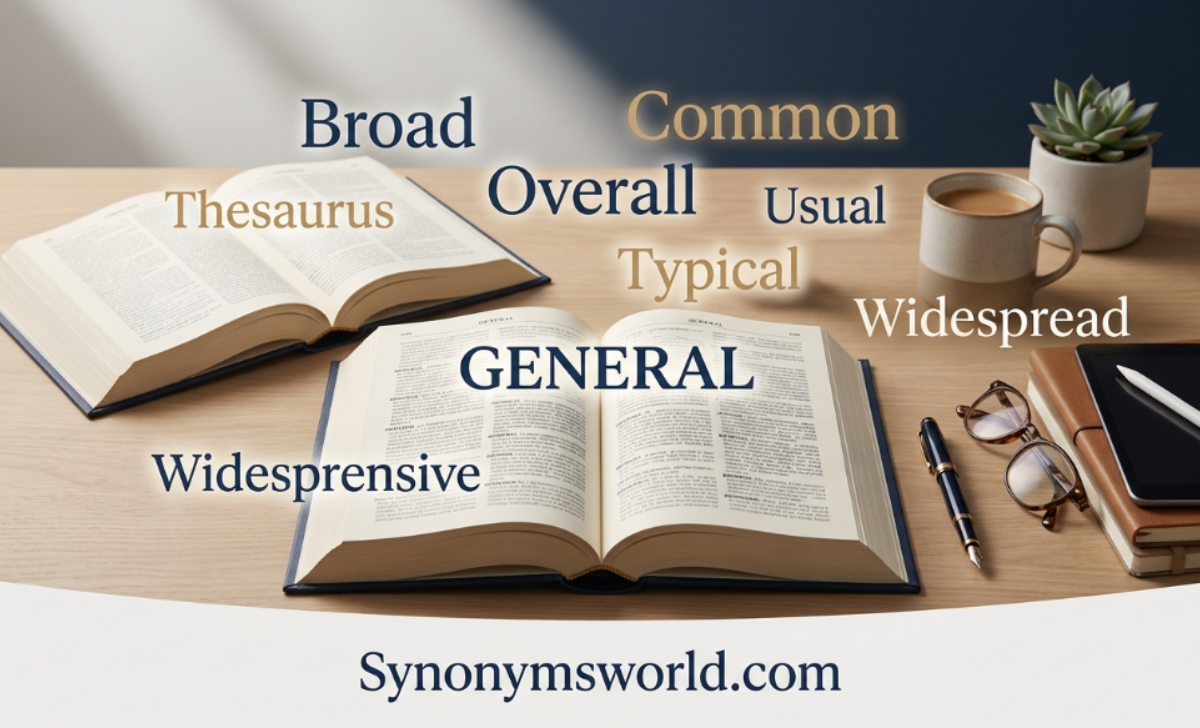
Have you ever used the word general several times in the same paragraph and felt that your writing sounded repetitive?
You are not alone. General is a useful English word, but it can have several meanings. It may describe something broad, common, usual, or related to a whole group.
For example, you might say, “She gave me a general idea of the project.” In this sentence, broad or overall may work better. But in “This is a general rule,” common or standard may be more suitable.
This guide explains general synonyms in simple English. It includes useful alternatives for students, bloggers, content writers, professionals, and daily English users.
You will also learn how to choose the right synonym for academic writing, informal speech, categories, and military contexts.
What Does “General” Mean?
General usually means something that covers many people, things, or situations rather than one specific case.
It can also mean something that is common or usual.
For example:
- The teacher gave a general explanation.
- This is a general problem among new learners.
- In general, people prefer simple instructions.
The meaning changes with context, so choosing the right synonym is important.
General Synonyms List
Below are 50 useful words and phrases related to different meanings of general. Some are close synonyms, while others are suitable alternatives only in particular contexts.
Common
Meaning: Something that happens often or exists in many places.
Examples:
- This is a common problem for beginners.
- Colds are common during winter.
Broad
Meaning: Covering many subjects, areas, or ideas.
Examples:
- The course gives a broad view of history.
- She has a broad knowledge of science.
Overall
Meaning: Considering everything together.
Examples:
- The overall result was positive.
- What is your overall opinion?
Usual
Meaning: Something that normally happens or is normally done.
Examples:
- He arrived at his usual time.
- I ordered my usual meal.
Typical
Meaning: Normal for a person, place, group, or situation.
Examples:
- This is typical behavior for a young child.
- Rain is typical here during spring.
Standard
Meaning: A normal or accepted level, type, or method.
Examples:
- The company follows standard procedures.
- This is the standard version of the product.
Ordinary
Meaning: Normal and not unusual or special.
Examples:
- It looked like an ordinary house.
- He wanted an ordinary family life.
Widespread
Meaning: Found among many people or in many places.
Examples:
- The story received widespread attention.
- Internet access is widespread today.
Universal
Meaning: Applying to everyone or everything in a group.
Examples:
- The need for food is universal.
- The rule is not universal.
Generic
Meaning: Not connected to one particular person, brand, or thing.
Examples:
- The doctor recommended a generic option.
- Use a generic term when the exact brand is not important.
Comprehensive
Meaning: Including all or most important parts of something.
Examples:
- The report provides a comprehensive review.
- We need a comprehensive plan.
Inclusive
Meaning: Including all members or parts of a group.
Examples:
- The school wants an inclusive environment.
- The policy takes an inclusive approach.
Extensive
Meaning: Covering a large amount or wide range.
Examples:
- She has extensive experience in teaching.
- The museum has an extensive collection.
Wide-Ranging
Meaning: Including many different subjects or areas.
Examples:
- The discussion covered wide-ranging topics.
- His interests are wide-ranging.
All-Encompassing
Meaning: Including almost everything within a subject.
Examples:
- They created an all-encompassing plan.
- The book offers an all-encompassing view.
Collective
Meaning: Shared by or involving a whole group.
Examples:
- The team made a collective decision.
- We need collective action.
Aggregate
Meaning: Made by combining several parts or amounts.
Examples:
- The report shows the aggregate results.
- We calculated the aggregate cost.
Commonplace
Meaning: Very common and not unusual.
Examples:
- Online shopping is now commonplace.
- These mistakes are commonplace among beginners.
Frequent
Meaning: Happening often.
Examples:
- Frequent practice improves your skills.
- The area has frequent power cuts.
Regular
Meaning: Normal, repeated, or happening often.
Examples:
- She is a regular visitor.
- Regular practice builds confidence.
Routine
Meaning: Normal and part of a usual pattern.
Examples:
- The doctor performed a routine check.
- Reading is part of my daily routine.
Normal
Meaning: Usual or expected.
Examples:
- It is normal to make mistakes while learning.
- The machine is working normally.
Average
Meaning: Ordinary or around the usual level.
Examples:
- The average student needs regular practice.
- The town gets average rainfall in summer.
Conventional
Meaning: Based on commonly accepted ideas or methods.
Examples:
- They used a conventional approach.
- She prefers conventional teaching methods.
Traditional
Meaning: Following an old or commonly used custom or method.
Examples:
- The restaurant serves traditional food.
- He prefers traditional learning methods.
Broad-Based
Meaning: Including many groups, areas, or types.
Examples:
- The project received broad-based support.
- They need a broad-based solution.
Generalized
Meaning: Described in a broad way without specific details.
Examples:
- His statement was too generalized.
- The lesson gives a generalized explanation.
Abstract
Meaning: Based on ideas rather than specific examples or things.
Examples:
- The teacher explained an abstract idea.
- The topic can seem abstract to beginners.
Vague
Meaning: Not clear, exact, or specific.
Examples:
- His answer was vague.
- The instructions were too vague.
Indefinite
Meaning: Not clearly fixed or limited.
Examples:
- The meeting was delayed for an indefinite period.
- She gave an indefinite answer.
Approximate
Meaning: Close to the exact amount or value but not exact.
Examples:
- Give me an approximate cost.
- The approximate travel time is three hours.
Broadly
Meaning: In a general way without focusing on small details.
Examples:
- Broadly, the plan was successful.
- The two ideas are broadly similar.
Generally
Meaning: In most cases or in a general way.
Examples:
- People generally prefer clear writing.
- The service is generally reliable.
Usually
Meaning: Most of the time.
Examples:
- I usually study at night.
- She usually walks to work.
Typically
Meaning: In the way that is normally expected.
Examples:
- The process typically takes two days.
- Students typically need more practice.
Ordinarily
Meaning: Normally or under usual conditions.
Examples:
- The store is ordinarily open until nine.
- I would ordinarily choose the cheaper option.
Commonly
Meaning: In a way that happens often or is widely accepted.
Examples:
- This word is commonly used in English.
- The term is commonly found in academic writing.
Universally
Meaning: In a way that applies to everyone or nearly everyone.
Examples:
- The idea is not universally accepted.
- The book was universally praised.
Broadly Speaking
Meaning: Used to give a general statement without small details.
Examples:
- Broadly speaking, the plan worked.
- Broadly speaking, both methods are useful.
On the Whole
Meaning: Considering everything together.
Examples:
- On the whole, the event was successful.
- On the whole, the students enjoyed the lesson.
For the Most Part
Meaning: Mostly or in most cases.
Examples:
- The instructions were clear for the most part.
- The project went well for the most part.
As a Whole
Meaning: Considering all parts together.
Examples:
- We should judge the project as a whole.
- The book works well as a whole.
By and Large
Meaning: Generally or mostly.
Examples:
- By and large, the feedback was positive.
- By and large, customers liked the service.
In Most Cases
Meaning: In the majority of situations.
Examples:
- In most cases, practice improves writing.
- In most cases, simple words are easier to understand.
Major
Meaning: Important or large in effect or importance.
Examples:
- Cost is a major concern.
- The company faced a major change.
Fundamental
Meaning: Basic and very important.
Examples:
- Grammar is fundamental to clear writing.
- Trust is fundamental to teamwork.
Primary
Meaning: First in importance or the main one.
Examples:
- Safety is our primary concern.
- The primary goal is better communication.
Formal Alternatives to “General”
If you need a more formal or academic synonym, choose a word that adds precision rather than simply sounding complicated.
Overall works when you mean considering everything.
Broad works when you mean covering many areas.
Comprehensive works when something includes most important details.
Widespread works when something exists across many people or places.
Generally works when you mean “in most cases.”
For example:
- General information → basic or broad information
- General view → overall view
- General knowledge → broad knowledge
- General trend → overall trend
- General approach → broad approach
General Synonyms for Academic Writing
Academic writing needs clear and precise vocabulary. The best synonym depends on the exact meaning.
Instead of saying:
“The paper gives a general discussion of the issue.”
You could write:
“The paper gives a broad discussion of the issue.”
Or:
“The paper provides an overall view of the issue.”
If the discussion includes many important details, comprehensive may be more accurate.
Avoid choosing a complicated synonym just to make your writing sound academic. Precision is more important than fancy vocabulary.
General Synonyms and Antonyms
The most common antonym of general is specific.
Other possible opposites include:
- Particular
- Detailed
- Exact
- Precise
- Specialized
- Narrow
- Individual
For example:
General: The report gives general information.
Specific: The report gives specific information about the costs.
The correct antonym depends on what general means in the sentence.
General vs. Specific
General describes something broad or not limited to one particular case.
Specific identifies one exact person, thing, detail, or situation.
Compare these examples:
- General information about the course
- Specific information about the course schedule
- A general question
- A specific question
- A general idea
- A specific idea
This difference is useful in academic writing, professional communication, and everyday English.
Synonyms for General in a Military Context
The word general has a separate meaning in the military. Here, it refers to a high military rank.
Words such as commander, officer, senior officer, or military leader may describe related roles, but they are not always exact synonyms for the rank general.
For example:
- The general addressed the soldiers.
- The senior military officer reviewed the plan.
So, when searching for synonyms for general military, you should first identify whether general means the military rank or a broad idea.
General Synonyms in Slang and Informal English
There is no single slang word that replaces general in every situation.
In casual English, people may use simpler alternatives such as basic, usual, common, broad, or overall, depending on the meaning.
For example:
- “That is the general idea.”
- “That is the basic idea.”
Here, basic can work in informal speech, but it cannot replace general in every sentence.
Another Word for General Category
When general describes a broad category, useful alternatives include broad, broad-based, inclusive, generic, and comprehensive.
For example, “animals” is a general category, while “dogs” is more specific.
A general category covers a wider group. A specific category narrows the focus.
How to Use “General” in a Sentence
The word general can be used in several ways:
- She gave me a general idea of the project.
- The teacher discussed general grammar rules.
- In general, people prefer simple instructions.
- He made a general statement about the problem.
- The general addressed the soldiers.
These examples show why you should check the meaning before choosing a synonym.
FAQs
1. What is another word for “general”?
Common alternatives include common, broad, overall, usual, typical, standard, ordinary, widespread, and universal.
2. What can I use instead of “general”?
You can use broad, overall, common, usual, typical, generic, comprehensive, or widespread, depending on the context.
3. How do you say “general” formally?
Formal alternatives can include overall, broad, comprehensive, widespread, and inclusive, depending on the intended meaning.
4. What is a better word for “general”?
Broad is often a good choice when you mean covering many areas. Overall is useful when you mean considering everything together.
5. What are 20 synonyms for “general”?
Twenty useful synonyms or alternatives include common, broad, overall, usual, typical, standard, ordinary, widespread, universal, generic, comprehensive, inclusive, extensive, collective, conventional, traditional, normal, frequent, regular, and fundamental.
6. What are 5 good synonyms for “general”?
Five useful choices are common, broad, overall, typical, and usual.
7. What are 5 strong synonyms for “general”?
Five strong alternatives are comprehensive, widespread, broad, extensive, and universal, depending on context.
8. What is a formal synonym for “general”?
Overall, comprehensive, broad, widespread, and inclusive can work as formal alternatives when their meanings fit the sentence.
9. What is the opposite of “general”?
The most common opposite is specific. Other possibilities include particular, exact, detailed, precise, narrow, and specialized.
10. What are synonyms for “general” in academic writing?
Useful academic alternatives include overall, broad, comprehensive, widespread, generalized, and generally. The best choice depends on the sentence.
Conclusion
Learning general synonyms can make your writing clearer and less repetitive. Words such as broad, common, overall, typical, widespread, comprehensive, and usual can help you express different meanings more accurately.
The key is to choose a synonym based on context. Practice these words in emails, essays, blog posts, school assignments, and daily conversations.
With regular use, you will become more confident in choosing the right word for every situation.
Read More Blogs: