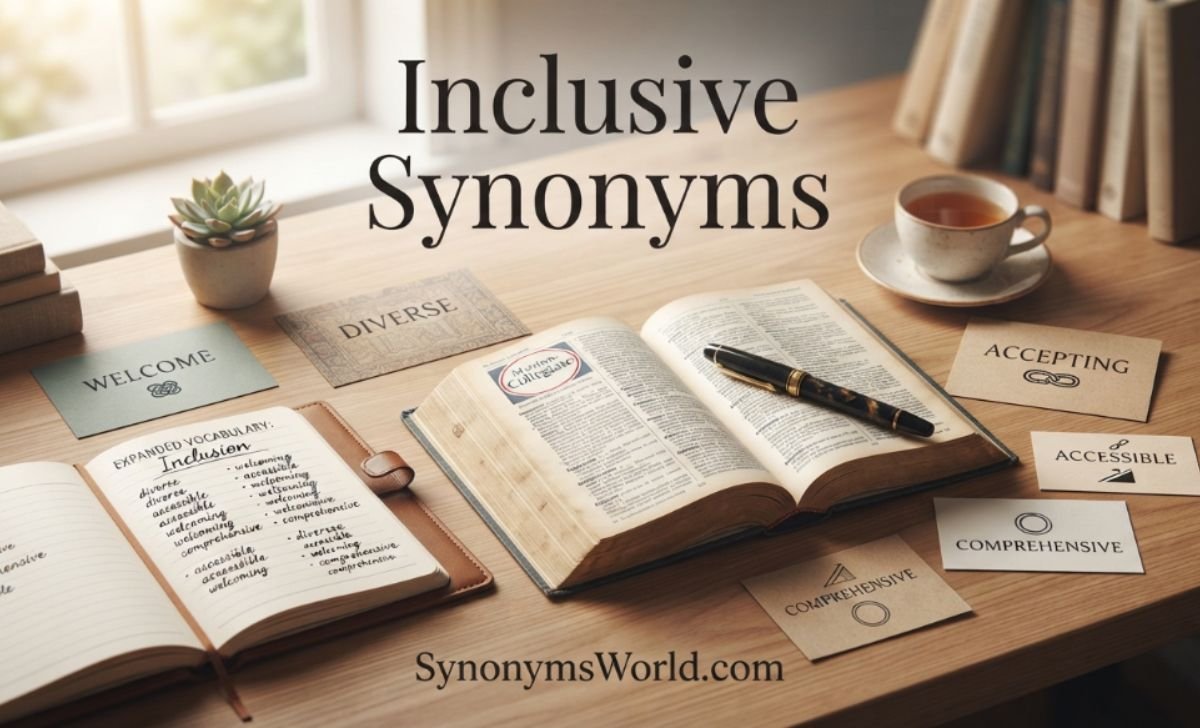
Have you ever used the word inclusive several times in the same article, email, or essay and wanted a better alternative? Choosing the right synonym can make your writing clearer and more natural.
The word inclusive can mean different things depending on context. It may describe something that includes everyone, covers all parts, welcomes different groups, or contains everything within a stated limit.
For example, an inclusive workplace welcomes people from different backgrounds, while an inclusive price already covers the listed costs.
This guide provides 50 inclusive synonyms with simple meanings and real-life examples.
These alternatives can help students, bloggers, content writers, professionals, and everyday English users vary their vocabulary without changing the intended meaning.
The goal is not simply to replace inclusive with another word, but to help you choose the word that fits your sentence best.
The structure and basic synonym-list format follow the supplied content instructions.
1. Comprehensive
Meaning: Including all or nearly all important parts of something.
Examples:
- The guide gives a comprehensive look at the topic.
- We need a comprehensive plan before we begin.
2. All-Inclusive
Meaning: Including everything that is needed or expected.
Examples:
- We booked an all-inclusive vacation package.
- The fee is all-inclusive, so there are no extra charges.
3. Broad
Meaning: Covering many different areas, ideas, or groups.
Examples:
- The course offers a broad range of topics.
- She has a broad understanding of modern marketing.
4. Wide-Ranging
Meaning: Covering many different subjects or areas.
Examples:
- The report contains wide-ranging research.
- His interests are wide-ranging and varied.
5. Extensive
Meaning: Covering a large amount or many parts of something.
Examples:
- The team carried out extensive research.
- The library has an extensive collection of books.
6. Complete
Meaning: Having all the parts that are needed.
Examples:
- Please send me the complete report.
- We finally have a complete list of participants.
7. Thorough
Meaning: Including careful attention to all important details.
Examples:
- The editor gave the article a thorough review.
- She conducted a thorough investigation.
8. All-Encompassing
Meaning: Including or covering everything within a particular area.
Examples:
- The company created an all-encompassing safety policy.
- We need an all-encompassing approach to the problem.
9. Universal
Meaning: Applying to everyone or everything in a particular group.
Examples:
- The program aims to provide universal access.
- Respect should be a universal value.
10. Open
Meaning: Willing to accept or include different people, ideas, or views.
Examples:
- The discussion is open to everyone.
- She is open to different opinions.
11. Welcoming
Meaning: Making people feel accepted and comfortable.
Examples:
- The school has a welcoming environment.
- The staff created a welcoming space for visitors.
12. Accepting
Meaning: Willing to respect people or ideas without rejecting them.
Examples:
- The community is accepting of different lifestyles.
- He grew up in an accepting family.
13. Accessible
Meaning: Easy for people to use, reach, understand, or take part in.
Examples:
- The website should be accessible to all users.
- The museum offers accessible facilities.
14. Diverse
Meaning: Including people or things that are different from one another.
Examples:
- The company has a diverse workforce.
- The festival attracts a diverse audience.
15. Representative
Meaning: Including people or examples that reflect a larger group.
Examples:
- The survey used a representative sample.
- We need a representative group of students.
16. Broad-Based
Meaning: Including many different groups, areas, or interests.
Examples:
- The project received broad-based support.
- The policy has broad-based appeal.
17. Holistic
Meaning: Considering all important parts of something together.
Examples:
- The school takes a holistic approach to learning.
- We need a holistic view of customer needs.
18. Extensive in Scope
Meaning: Covering many parts or areas of a subject.
Examples:
- The study is extensive in scope.
- The project is extensive in scope and detail.
19. Sweeping
Meaning: Covering a large area, group, or range.
Examples:
- The new law introduced sweeping changes.
- The report makes sweeping recommendations.
20. Far-Reaching
Meaning: Affecting or covering many areas or people.
Examples:
- The decision could have far-reaching effects.
- The reform brought far-reaching changes.
21. Multidimensional
Meaning: Including several different aspects or sides.
Examples:
- The issue requires a multidimensional approach.
- Her research gives a multidimensional view of the problem.
22. Multifaceted
Meaning: Having many different parts, features, or aspects.
Examples:
- Climate change is a multifaceted issue.
- The campaign uses a multifaceted strategy.
23. Wide
Meaning: Covering many people, things, or areas.
Examples:
- The announcement received wide attention.
- The program serves a wide audience.
24. All-Sided
Meaning: Considering or including different sides of an issue.
Examples:
- The article provides an all-sided discussion.
- We need an all-sided review before deciding.
25. Full
Meaning: Containing all the needed information, parts, or details.
Examples:
- The website provides a full explanation.
- Please give us a full account of what happened.
26. Exhaustive
Meaning: Covering every important part or possibility.
Examples:
- The researchers performed an exhaustive search.
- The report provides an exhaustive list of options.
27. Detailed
Meaning: Including many useful facts or pieces of information.
Examples:
- She wrote a detailed guide for beginners.
- The manager gave detailed instructions.
28. Inclusive of
Meaning: Including a particular thing or group as part of something larger.
Examples:
- The price is inclusive of taxes.
- The package is inclusive of breakfast.
29. Integrative
Meaning: Combining different parts or ideas into one whole.
Examples:
- The program uses an integrative learning model.
- They developed an integrative solution to the problem.
30. Integrated
Meaning: Combining different parts so they work together.
Examples:
- The company offers an integrated support system.
- We need an integrated approach to customer service.
31. Unified
Meaning: Bringing different people or parts together as one group.
Examples:
- The team presented a unified message.
- The campaign created a unified community.
32. Collaborative
Meaning: Involving people working together and sharing ideas.
Examples:
- The project uses a collaborative approach.
- We created a collaborative space for students.
33. Participatory
Meaning: Allowing people to take part in an activity or decision.
Examples:
- The workshop uses a participatory teaching style.
- The city introduced a participatory planning process.
34. Egalitarian
Meaning: Based on equal rights, opportunities, or treatment.
Examples:
- The organization promotes an egalitarian workplace.
- They wanted to build a more egalitarian system.
35. Equitable
Meaning: Fair and giving people appropriate opportunities or treatment.
Examples:
- The school aims to provide equitable access to education.
- We need an equitable hiring process.
36. Impartial
Meaning: Treating different people or sides fairly without favoritism.
Examples:
- The judge must remain impartial.
- We need an impartial review of the complaint.
37. Nonexclusive
Meaning: Not limited to one person, group, or category.
Examples:
- Membership is nonexclusive and open to everyone.
- The offer is nonexclusive.
38. Unrestricted
Meaning: Not limited by rules, conditions, or boundaries.
Examples:
- The event provides unrestricted access to the main area.
- Students have unrestricted access to the library.
39. All-Embracing
Meaning: Including many or all people, ideas, or aspects.
Examples:
- The organization has an all-embracing mission.
- They proposed an all-embracing plan for reform.
40. Encompassing
Meaning: Including or covering a wide range of things.
Examples:
- The course has an encompassing curriculum.
- The policy takes an encompassing view of public needs.
41. Covering
Meaning: Including a particular range of people, topics, or things.
Examples:
- The course is covering several areas of business.
- The report is covering the main causes of the issue.
42. Incorporating
Meaning: Including something as part of a larger whole.
Examples:
- The new design incorporates user feedback.
- The lesson plan incorporates different learning styles.
43. Including
Meaning: Having someone or something as part of a group or whole.
Examples:
- The price includes delivery.
- The team includes experts from several fields.
44. Accommodating
Meaning: Willing or able to meet different needs.
Examples:
- The hotel is accommodating to families.
- Her manager was accommodating when she requested flexible hours.
45. Tolerant
Meaning: Accepting differences without treating them negatively.
Examples:
- The community is tolerant of different opinions.
- Schools should encourage tolerant attitudes.
46. Pluralistic
Meaning: Accepting and supporting different groups, beliefs, or views.
Examples:
- The city has a pluralistic culture.
- A pluralistic society allows different voices to be heard.
47. Non-Discriminatory
Meaning: Treating people fairly without unfair exclusion.
Examples:
- The company follows a non-discriminatory hiring policy.
- Schools should provide non-discriminatory access to education.
48. Open-Minded
Meaning: Willing to consider different ideas or opinions.
Examples:
- She is open-minded about new teaching methods.
- An open-minded manager listens to the whole team.
49. Community-Oriented
Meaning: Focused on serving and involving a whole community.
Examples:
- The center runs community-oriented programs.
- They created a community-oriented health campaign.
50. Inclusive-Minded
Meaning: Focused on accepting and involving different people and perspectives.
Examples:
- The organization promotes an inclusive-minded culture.
- An inclusive-minded leader makes room for different voices.
How to Choose the Right Inclusive Synonym
Not every synonym for inclusive works in every sentence. The best choice depends on what you want to say.
Use comprehensive, thorough, or exhaustive when you mean something covers a subject in detail.
Use welcoming, accepting, open, or accessible when you are talking about people and participation.
Diverse, representative, or pluralistic when you want to highlight differences within a group.
Equitable, egalitarian, or non-discriminatory when the focus is fairness and equal treatment.
All-inclusive when something literally includes everything that is part of the stated offer or package.
For example, these sentences are not interchangeable:
- The guide is comprehensive.
- The workplace is welcoming.
- The team is diverse.
- The hiring policy is equitable.
- The vacation package is all-inclusive.
They all relate to the broad idea of inclusion, but each word adds a different shade of meaning.
Inclusive Synonyms for Different Contexts
For People and Communities
Good choices include:
- welcoming
- accepting
- diverse
- accessible
- open
- pluralistic
- tolerant
- community-oriented
For Writing and Information
Good choices include:
- comprehensive
- thorough
- complete
- extensive
- detailed
- exhaustive
- wide-ranging
For Policies and Workplaces
Good choices include:
- equitable
- egalitarian
- non-discriminatory
- representative
- participatory
- accessible
For Prices and Packages
The most natural choices are often:
- all-inclusive
- inclusive of
- including
- complete
For example:
The $200 price is inclusive of taxes.
This is more precise than simply replacing inclusive with a general synonym.
FAQs
1. What is the best synonym for inclusive?
Comprehensive is a strong synonym when inclusive means covering all important parts. For people and communities, welcoming, accepting, or open may be more natural.
2. What is another word for inclusive?
Depending on the context, alternatives include comprehensive, all-inclusive, broad, welcoming, accepting, diverse, accessible, equitable, and wide-ranging.
3. What is a synonym for inclusive in the workplace?
Useful choices include welcoming, equitable, diverse, accepting, accessible, and non-discriminatory.
4. What is a synonym for inclusive pricing?
All-inclusive and inclusive of are common choices. For example, “The price is inclusive of tax.”
5. What is the opposite of inclusive?
Common opposites include exclusive, limited, restrictive, selective, and excluding, depending on the context.
6. Is comprehensive the same as inclusive?
Not always. Comprehensive usually means covering all or most important parts of a subject, while inclusive can also mean welcoming or involving different people and groups.
7. Is diverse a synonym for inclusive?
Sometimes, but the words are not identical. Diverse describes differences within a group, while inclusive focuses more on welcoming, involving, or including people.
8. What is a formal synonym for inclusive?
Depending on the context, comprehensive, encompassing, equitable, integrative, or all-encompassing can work in formal writing.
9. What is a simple synonym for inclusive?
Simple alternatives include open, welcoming, accepting, broad, and complete. The best choice depends on the sentence.
10. How can I avoid repeating the word inclusive?
First identify what inclusive means in your sentence. Then choose a more precise alternative such as comprehensive for coverage, welcoming for people, equitable for fairness, or all-inclusive for packages.
Conclusion
Learning inclusive synonyms can make your writing more precise, natural, and engaging. Instead of using inclusive repeatedly, choose a word that matches your exact meaning.
Comprehensive works well for information, welcoming for people, equitable for fair treatment, and all-inclusive for packages or offers.
Try these alternatives in your emails, essays, blog posts, workplace writing, and daily conversations. The more you use them in real sentences, the easier it becomes to choose the right word naturally.