Have you ever had a day that felt the same from morning to night? You wake up, go to work or school, finish your usual tasks, and repeat the same routine.
You might call such a day mundane. The word describes something ordinary, routine, or lacking excitement.
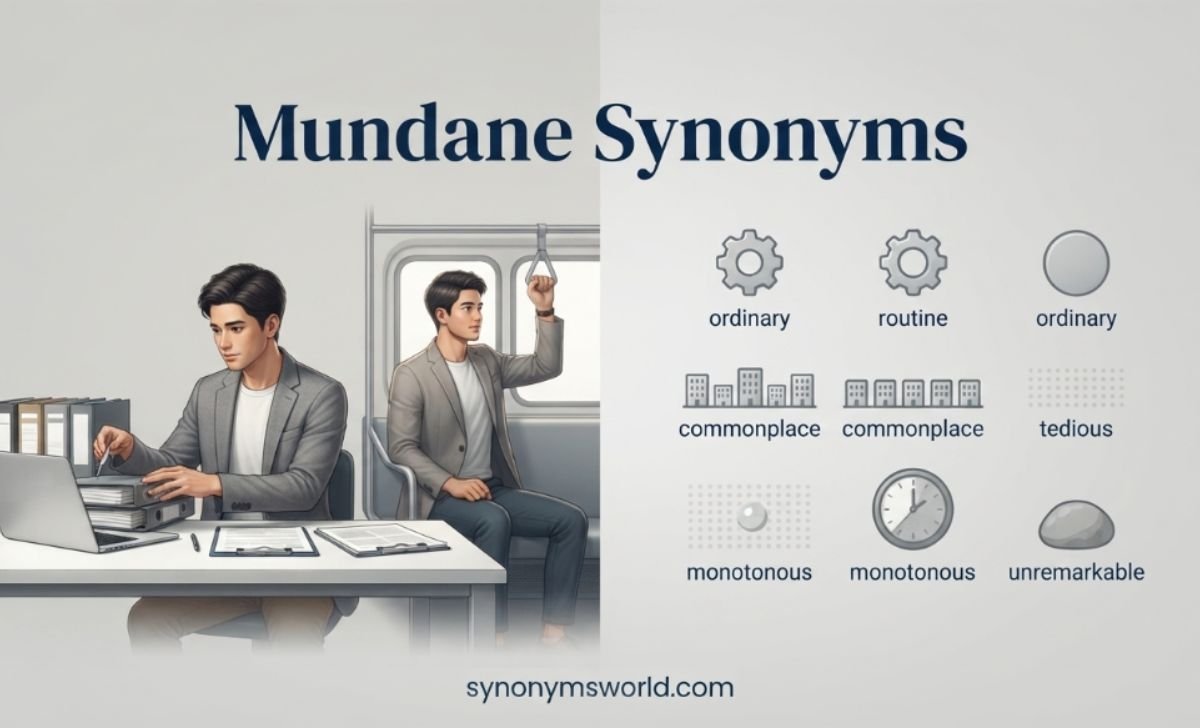
Learning mundane synonyms can help you choose a better word for the exact feeling you want to express.
For example, ordinary is neutral, while tedious suggests that something feels boring or tiring.
Monotonous focuses on repetition, and commonplace means something is very usual or not special.
This guide gives you 50 useful synonyms for mundane, with simple meanings and natural examples.
These words can help students, bloggers, content writers, and everyday English users make their writing and speaking more varied.
1. Ordinary
Meaning: Something normal that is not unusual or special.
Examples:
- It was an ordinary Monday at the office.
- She wore an ordinary black jacket.
2. Routine
Meaning: Something done regularly in the same usual way.
Examples:
- My morning routine starts with a cup of tea.
- The daily routine became easy to follow.
3. Commonplace
Meaning: Something that happens often and is not unusual.
Examples:
- Online meetings are commonplace today.
- Such mistakes are commonplace among beginners.
4. Everyday
Meaning: Something used or experienced as part of normal daily life.
Examples:
- Cooking is an everyday task for many people.
- She finds joy in everyday activities.
5. Unremarkable
Meaning: Something that is ordinary and does not attract attention.
Examples:
- The hotel room was clean but unremarkable.
- He described the meeting as unremarkable.
6. Typical
Meaning: Something that is normal for a person, place, or situation.
Examples:
- It was a typical day at school.
- That is a typical family dinner.
7. Normal
Meaning: Something that is usual or expected.
Examples:
- Feeling tired after work is normal.
- It was a normal evening at home.
8. Average
Meaning: Something that is usual but not especially good or impressive.
Examples:
- The restaurant served an average meal.
- His day was fairly average.
9. Standard
Meaning: Something that follows the usual level or form.
Examples:
- The company follows a standard process.
- This is a standard office task.
10. Familiar
Meaning: Something that is well known because you have experienced it before.
Examples:
- The quiet street looked familiar.
- She enjoyed the familiar comfort of home.
11. Banal
Meaning: Something so ordinary that it seems boring or uninteresting.
Examples:
- The article was filled with banal ideas.
- They had a banal conversation about the weather.
12. Boring
Meaning: Something that does not interest or excite you.
Examples:
- The lecture was boring.
- Cleaning the garage can be boring.
13. Dull
Meaning: Something that is not exciting, interesting, or lively.
Examples:
- The movie had a dull ending.
- It was a dull afternoon.
14. Tedious
Meaning: Something that is boring because it takes a long time or requires repeated effort.
Examples:
- Checking every file was tedious.
- The tedious task took all afternoon.
15. Monotonous
Meaning: Something that repeats in the same way and becomes boring.
Examples:
- His monotonous job made him feel tired.
- The speaker’s voice became monotonous.
16. Repetitive
Meaning: Something that happens again and again in nearly the same way.
Examples:
- The work became repetitive after a few hours.
- Repetitive tasks can reduce attention.
17. Humdrum
Meaning: Something ordinary, dull, and lacking excitement.
Examples:
- He wanted to escape his humdrum routine.
- Her humdrum life changed after the trip.
18. Prosaic
Meaning: Something ordinary and lacking imagination or excitement.
Examples:
- The story began with a prosaic description.
- His daily concerns were quite prosaic.
19. Insipid
Meaning: Something that lacks excitement, interest, or strong character.
Examples:
- The conversation felt insipid.
- The meal was simple and insipid.
20. Trivial
Meaning: Something small or unimportant.
Examples:
- They argued over a trivial issue.
- Do not waste time on trivial problems.
21. Predictable
Meaning: Something that happens in a way that is easy to expect.
Examples:
- The ending was predictable.
- His daily schedule was predictable.
22. Unexciting
Meaning: Something that does not create interest or excitement.
Examples:
- The first part of the trip was unexciting.
- The game became unexciting after halftime.
23. Drab
Meaning: Something dull, plain, or lacking energy.
Examples:
- The office looked drab and old.
- He wanted to brighten his drab room.
24. Lifeless
Meaning: Something that seems to have little energy, activity, or interest.
Examples:
- The party felt lifeless.
- The empty street looked lifeless at night.
25. Uninspiring
Meaning: Something that does not give you interest, energy, or new ideas.
Examples:
- The presentation was uninspiring.
- He left the uninspiring workplace.
26. Uninteresting
Meaning: Something that does not hold your attention.
Examples:
- The book became uninteresting after the first chapter.
- The meeting was long and uninteresting.
27. Tedious
Meaning: Something that becomes tiring because it is boring or repetitive.
Examples:
- Sorting the documents was tedious.
- She found the long process tedious.
28. Mundane
Meaning: Something ordinary, routine, or lacking excitement.
Examples:
- He wanted a break from his mundane routine.
- Even mundane tasks can be useful.
29. Routine-like
Meaning: Something that follows a regular and repeated pattern.
Examples:
- The work felt routine-like after several months.
- His routine-like schedule left little free time.
30. Conventional
Meaning: Something that follows common or traditional ways.
Examples:
- They chose a conventional design.
- His approach was conventional but effective.
31. Unexceptional
Meaning: Something that is ordinary and not better or worse than usual.
Examples:
- The meal was pleasant but unexceptional.
- His performance was unexceptional that day.
32. Run-of-the-mill
Meaning: Something ordinary and not special.
Examples:
- It was a run-of-the-mill office job.
- The shop sells run-of-the-mill products.
33. Ho-hum
Meaning: Something boring, ordinary, or not exciting.
Examples:
- The movie was rather ho-hum.
- The weekend felt ho-hum without any plans.
34. Lackluster
Meaning: Something that has little energy, excitement, or quality.
Examples:
- The team gave a lackluster performance.
- Sales were lackluster last month.
35. Colorless
Meaning: Something that lacks excitement, variety, or personality.
Examples:
- His writing sounded colorless.
- The story gave a colorless view of city life.
36. Unvaried
Meaning: Something that has little change or variety.
Examples:
- She followed an unvaried diet for months.
- His work schedule was unvaried.
37. Repetitious
Meaning: Something that contains too much repetition.
Examples:
- The speech became repetitious.
- The instructions were clear but repetitious.
38. Formulaic
Meaning: Something made according to the same fixed pattern.
Examples:
- The movie felt formulaic.
- His articles became formulaic over time.
39. Stale
Meaning: Something that has become boring because it is old or repeated too often.
Examples:
- The discussion was becoming stale.
- They needed fresh ideas to replace the stale routine.
40. Static
Meaning: Something that stays the same without change or development.
Examples:
- His daily life felt static.
- The project became static after the first month.
41. Uneventful
Meaning: Something that happens without anything unusual or exciting.
Examples:
- The flight was long but uneventful.
- We had an uneventful journey home.
42. Unadventurous
Meaning: Something that avoids risk, change, or excitement.
Examples:
- He preferred an unadventurous lifestyle.
- Their travel plans were safe and unadventurous.
43. Pedestrian
Meaning: Something ordinary and lacking imagination or excitement.
Examples:
- The article offered a pedestrian view of the issue.
- The plot felt pedestrian and predictable.
44. Prosaic
Meaning: Something ordinary and practical rather than exciting or imaginative.
Examples:
- They discussed the prosaic details of moving house.
- His concerns were mostly prosaic.
45. Workaday
Meaning: Something ordinary and connected with regular daily work.
Examples:
- She wanted a break from her workaday life.
- The painting showed a workaday scene.
46. Average-looking
Meaning: Something that looks normal without being especially noticeable.
Examples:
- He lived in an average-looking house.
- The building seemed average-looking from outside.
47. Plain
Meaning: Something simple and without special features.
Examples:
- She chose a plain white shirt.
- The room had plain walls.
48. Unassuming
Meaning: Something modest and not designed to attract attention.
Examples:
- The restaurant looked unassuming from outside.
- He lived in an unassuming apartment.
49. Common
Meaning: Something found or experienced often by many people.
Examples:
- Traffic is a common problem in large cities.
- This is a common daily task.
50. Matter-of-fact
Meaning: Something presented in a simple, practical, and unemotional way.
Examples:
- She gave a matter-of-fact answer.
- His matter-of-fact tone made the story feel ordinary.
How to Choose the Right Synonym for Mundane
Not every synonym for mundane has exactly the same meaning. The best choice depends on what you want to say.
Use ordinary, normal, or everyday when you simply mean something usual. These words are mostly neutral.
Boring, dull, tedious, or uninteresting when you want to show that something is not enjoyable.
Use monotonous, repetitive, or repetitious when the main problem is repetition.
Commonplace, typical, or conventional when you want to describe something common or expected.
Use banal, prosaic, humdrum, or pedestrian when you want a stronger or more formal description of something lacking freshness or excitement.
Mundane Meaning and Definition
The word mundane usually means ordinary, everyday, or lacking excitement. It can describe a routine, task, conversation, job, experience, or part of daily life.
For example:
The employee finished his mundane tasks before lunch.
Here, mundane suggests that the tasks were ordinary and possibly boring.
The word can also have a different meaning in some contexts: mundane can refer to the ordinary physical world rather than something spiritual or heavenly. The surrounding sentence tells you which meaning is intended.
Mundane Synonyms and Antonyms
Some common synonyms for mundane are:
- Ordinary
- Everyday
- Routine
- Commonplace
- Boring
- Dull
- Tedious
- Monotonous
- Repetitive
- Humdrum
- Banal
- Unremarkable
Common antonyms include:
- Exciting
- Extraordinary
- Remarkable
- Fascinating
- Interesting
- Unusual
- Novel
- Adventurous
- Spectacular
- Stimulating
The right antonym depends on context. For example, exciting is a natural opposite when talking about an experience, while extraordinary works well when comparing something unusual with something ordinary.
Another Word for Mundane Tasks
If you need another word for mundane tasks, several choices work well:
- Routine tasks
- Everyday tasks
- Repetitive tasks
- Tedious tasks
- Ordinary chores
- Daily responsibilities
- Repetitive work
- Common duties
For example, “I spent the morning doing mundane tasks” could become “I spent the morning doing routine tasks.” If the tasks were tiring, tedious tasks may be a better choice.
Synonym for Mundane Life
When describing a mundane life, the best synonym depends on the feeling you want to express.
- Ordinary life — neutral
- Routine life — focuses on repetition
- Humdrum life — suggests boredom
- Unexciting life — directly highlights a lack of excitement
- Monotonous life — emphasizes repetition
- Conventional life — focuses on a traditional pattern
- Workaday life — focuses on normal daily living
For example, “He wanted to escape his mundane life” could become “He wanted to escape his humdrum life.”
Mundane Synonyms: Ordinary vs. Boring
Ordinary and boring are related, but they are not always interchangeable.
Ordinary simply means normal or not special. It does not always mean something is unpleasant.
Boring means something fails to hold your interest.
For example:
- “She had an ordinary day.” — The day was normal.
- “She had a boring day.” — The day was not interesting.
This distinction is important when choosing a synonym for mundane.
Mundane Synonyms in Slang and Informal English
There is no single slang word that replaces mundane in every situation. Informal expressions such as ho-hum, same old, nothing special, and run-of-the-mill can work depending on the sentence.
For example:
- “It was the same old routine.”
- “The movie was nothing special.”
- “It was a run-of-the-mill day.”
These expressions are more casual than words such as prosaic, banal, or unexceptional.
Positive Synonyms for Mundane
Sometimes you may want a more positive word instead of mundane. In that case, ordinary, everyday, familiar, simple, or unassuming can work.
For example, instead of saying:
She enjoys her mundane routine.
You could say:
She enjoys her simple daily routine.
The second sentence sounds warmer and does not suggest that the routine is boring.
Mundane in a Sentence
Here are several natural examples:
- The office routine became mundane after a few years.
- Even mundane chores need to be completed.
- He enjoys finding beauty in mundane moments.
- The writer turned a mundane event into an interesting story.
- She wanted something different from her mundane routine.
- Mundane tasks can become easier with a good schedule.
FAQs
1. What is the best synonym for mundane?
Ordinary is one of the closest general synonyms for mundane. Depending on context, routine, everyday, commonplace, dull, tedious, or monotonous may be more precise.
2. What does mundane mean in simple English?
Mundane means ordinary, everyday, or not exciting. It can describe things that happen as part of normal daily life.
3. Is ordinary a synonym for mundane?
Yes. Ordinary is a common synonym for mundane when the meaning is something normal or not special.
4. Is boring the same as mundane?
Not exactly. Mundane often means ordinary or routine, while boring specifically means that something does not interest or excite you.
5. What is another word for mundane tasks?
Common choices include routine tasks, everyday tasks, repetitive tasks, tedious tasks, and daily responsibilities.
6. What is a synonym for mundane life?
Depending on the meaning, you can use ordinary life, routine life, humdrum life, monotonous life, or unexciting life.
7. What is the opposite of mundane?
Common antonyms include exciting, extraordinary, remarkable, unusual, fascinating, adventurous, and spectacular.
8. What is a positive synonym for mundane?
Everyday, ordinary, simple, familiar, and unassuming can sound more positive or neutral than mundane.
9. What are formal synonyms for mundane?
Formal or literary alternatives include prosaic, banal, commonplace, unexceptional, pedestrian, and conventional, depending on context.
10. Can mundane describe a person?
Yes, but it is more natural to describe a person’s life, routine, work, ideas, activities, or conversation as mundane. Calling a person mundane can sound critical because it may suggest that the person is dull or ordinary.
Conclusion
Learning mundane synonyms gives you more ways to describe ordinary life, routine work, daily tasks, and unexciting experiences.
Words such as ordinary, everyday, commonplace, tedious, monotonous, repetitive, and humdrum each add a slightly different meaning.
Choosing the right synonym makes your writing clearer and more natural. Students can use these words in essays, bloggers can avoid repetition, and content writers can make their sentences more engaging.
Practice these synonyms in emails, essays, and daily conversations to build a stronger English vocabulary.
Read More…