Finding the right word can make your writing clearer. If you often use primary, you may want another word to avoid repetition.
The word primary can mean first, most important, main, or basic, depending on the context. For example, you might say, “The primary goal is to improve sales.” You could also say, “The main goal is to improve sales.”
This guide explores primary synonyms with simple meanings and real-life examples. These words can help students, bloggers, content writers, professionals, and daily English users choose better vocabulary.
Some words work well in formal writing, while others fit casual speech. Understanding the small differences between them is important.
Whether you need a synonym for primary, a professional alternative, or a word for academic writing, this list gives you useful choices.
Main
Meaning: Main means the most important or central part of something.
Examples:
- Our main goal is to help customers.
- The main road is closed today.
Principal
Meaning: Principal means the most important person or thing in a situation.
Examples:
- Safety is our principal concern.
- The principal reason was lack of time.
Chief
Meaning: Chief means the highest in importance or rank.
Examples:
- Her chief concern was the cost.
- The chief reason for the change was safety.
Major
Meaning: Major means very important, large, or serious.
Examples:
- This is a major problem for the team.
- Cost is a major factor in our decision.
Leading
Meaning: Leading means most important or ahead of others.
Examples:
- She is a leading expert in the field.
- The company is a leading provider of software.
Central
Meaning: Central means most important to a subject or situation.
Examples:
- Trust is central to a good relationship.
- The central issue is customer service.
Key
Meaning: Key means very important to success or understanding.
Examples:
- Communication is a key skill.
- Time is a key part of the plan.
Essential
Meaning: Essential means absolutely needed or very important.
Examples:
- Water is essential for life.
- Good planning is essential for success.
Fundamental
Meaning: Fundamental means basic and very important.
Examples:
- Trust is fundamental to teamwork.
- These are fundamental English skills.
Core
Meaning: Core means the central or most important part.
Examples:
- Writing is a core skill for students.
- Customer care is our core business.
Foremost
Meaning: Foremost means the most important or highest in rank.
Examples:
- Safety is our foremost priority.
- Her foremost aim is to improve quality.
First
Meaning: First means coming before others in time, order, or importance.
Examples:
- Health should come first.
- He was the first person to arrive.
Initial
Meaning: Initial means happening or existing at the beginning.
Examples:
- The initial plan worked well.
- We discussed the initial results.
Important
Meaning: Important means having great value or effect.
Examples:
- This is an important decision.
- Family is important to many people.
Basic
Meaning: Basic means simple, essential, or forming the starting point.
Examples:
- Students need basic writing skills.
- We covered the basic rules first.
Primary-Level
Meaning: Primary-level means related to the first or basic stage of learning.
Examples:
- She teaches primary-level students.
- The course covers primary-level math.
Foundational
Meaning: Foundational means forming the base for something else.
Examples:
- Reading is a foundational skill.
- These lessons provide foundational knowledge.
Underlying
Meaning: Underlying means existing beneath or supporting something.
Examples:
- We need to find the underlying cause.
- The report explains the underlying problem.
Dominant
Meaning: Dominant means more powerful, noticeable, or important than others.
Examples:
- English is the dominant language in the course.
- One theme is dominant throughout the book.
Predominant
Meaning: Predominant means more common or important than other things.
Examples:
- The predominant reason was cost.
- Blue was the predominant color in the design.
Preeminent
Meaning: Preeminent means better or more important than others.
Examples:
- She is a preeminent scholar in her field.
- Quality is the preeminent concern.
Paramount
Meaning: Paramount means more important than anything else.
Examples:
- Safety is paramount during the project.
- Customer trust is paramount to the company.
Vital
Meaning: Vital means extremely important or necessary.
Examples:
- Sleep is vital for good health.
- Clear instructions are vital for the task.
Crucial
Meaning: Crucial means extremely important to a result.
Examples:
- Timing was crucial to the plan.
- Your feedback is crucial to our work.
Critical
Meaning: Critical means very important or necessary.
Examples:
- This is a critical step in the process.
- Good data is critical for the study.
Significant
Meaning: Significant means important enough to have an effect.
Examples:
- The change had a significant impact.
- There was a significant rise in sales.
Substantial
Meaning: Substantial means large or important in amount or effect.
Examples:
- The company made a substantial investment.
- We saw a substantial improvement.
Salient
Meaning: Salient means the most noticeable or important part.
Examples:
- The report highlights the salient points.
- One salient issue needs more attention.
Forefront
Meaning: Forefront means the leading or most important position.
Examples:
- Technology is at the forefront of the project.
- She remains at the forefront of research.
First-Rank
Meaning: First-rank means among the most important or best.
Examples:
- He is a first-rank expert.
- The university has a first-rank research team.
Top
Meaning: Top means highest in importance, rank, or quality.
Examples:
- Customer service is our top priority.
- She is a top choice for the role.
Priority
Meaning: Priority means something that is treated as more important than others.
Examples:
- Safety is our top priority.
- Finishing the work is my priority.
Focus
Meaning: Focus means the main thing receiving attention.
Examples:
- The focus of the meeting was sales.
- Education is the main focus of the program.
Purpose
Meaning: Purpose means the main reason something exists or is done.
Examples:
- The primary purpose is to educate users.
- The purpose of this guide is simple.
Objective
Meaning: Objective means a goal that someone wants to achieve.
Examples:
- Our main objective is growth.
- The project has one clear objective.
Aim
Meaning: Aim means the result or goal someone wants to reach.
Examples:
- Our main aim is to save time.
- The campaign aims to increase awareness.
Goal
Meaning: Goal means something you want to achieve.
Examples:
- Our primary goal is customer satisfaction.
- Her goal is to become a better writer.
Reason
Meaning: Reason means the cause or explanation for something.
Examples:
- The primary reason was the high cost.
- What is the main reason for the delay?
Factor
Meaning: Factor means something that helps cause a result.
Examples:
- Price was a primary factor in our choice.
- Time is an important factor here.
Role
Meaning: Role means the part someone or something plays in a situation.
Examples:
- Education has a primary role in development.
- Trust plays a key role in business.
Function
Meaning: Function means the main job or purpose of something.
Examples:
- The primary function is to store data.
- This button has one simple function.
Source
Meaning: Source means the place or person from which information comes.
Examples:
- The study used a primary source.
- We checked the original source.
Original
Meaning: Original means existing from the beginning or coming directly from its source.
Examples:
- The researcher used an original document.
- Keep the original file for your records.
Firsthand
Meaning: Firsthand means coming directly from personal experience or direct observation.
Examples:
- She gave us firsthand information.
- I learned about the event firsthand.
Direct
Meaning: Direct means coming straight from the source without an intermediary.
Examples:
- We received direct information from the manager.
- The report gives a direct account of the event.
Immediate
Meaning: Immediate means happening first or needing attention without delay.
Examples:
- Our immediate concern is safety.
- The team took immediate action.
Earliest
Meaning: Earliest means happening before all other times or stages.
Examples:
- We studied the earliest records.
- The earliest version had fewer features.
Beginning
Meaning: Beginning means the first part or stage of something.
Examples:
- We discussed the beginning stage first.
- The beginning steps are easy to follow.
Elementary
Meaning: Elementary means basic or suitable for beginners.
Examples:
- The book uses elementary English.
- These are elementary grammar rules.
Introductory
Meaning: Introductory means designed to introduce a subject to beginners.
Examples:
- I took an introductory writing course.
- This is an introductory guide to English.
Base
Meaning: Base means the lowest or supporting part of something.
Examples:
- Trust forms the base of a strong team.
- These skills provide a solid base for learning.
Bedrock
Meaning: Bedrock means the strongest basic part on which something is built.
Examples:
- Honesty is the bedrock of trust.
- Practice is the bedrock of good writing.
What Does “Primary” Mean?
The word primary usually means first, main, most important, or basic. Its exact meaning depends on the sentence.
For example:
- Primary goal = main goal
- Primary reason = main reason
- Primary source = original source
- Primary school = school for young children
- Primary concern = most important concern
This is why one synonym does not always work in every sentence.
Primary Synonyms and Antonyms
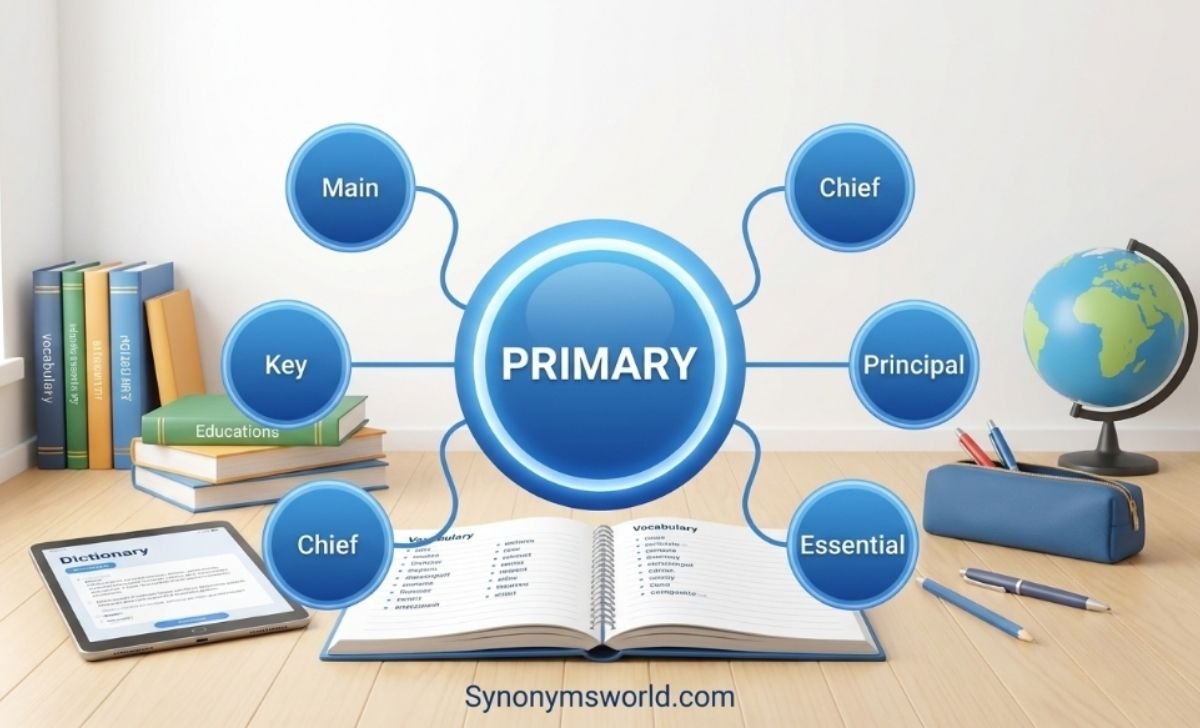
The best synonym depends on the meaning of primary. Common synonyms include main, principal, chief, major, central, key, essential, core, and foremost.
The opposite of primary is often secondary. However, other antonyms may fit different contexts, such as minor, subordinate, less important, later, or supplementary.
For example:
- Primary concern → secondary concern
- Primary source → secondary source
- Primary objective → secondary objective
Primary vs. Secondary
Primary describes something that comes first in importance, order, or position. Secondary describes something that comes after it or has less importance.
| Primary | Secondary |
|---|---|
| Main | Additional |
| First in importance | Less important |
| Chief | Supporting |
| Central | Related |
| Original source | Later source |
Example:
“The primary goal is safety, while the secondary goal is comfort.”
What Is Another Word for “Primary”?
The best general replacement for primary is usually main. It is simple, natural, and works in many everyday sentences.
Other choices include:
- Principal
- Chief
- Major
- Central
- Key
- Essential
- Core
- Foremost
Choose the word based on your meaning and audience.
Professional Alternatives to “Primary”
In professional writing, these alternatives can sound natural:
- Principal
- Key
- Main
- Chief
- Core
- Central
- Leading
- Fundamental
- Critical
- Essential
For example, instead of “the primary objective,” you can write “the principal objective” or “the main objective.”
Another Word for “Primarily”
Primarily means mainly or mostly.
Useful synonyms include:
- Mainly
- Mostly
- Chiefly
- Principally
- Largely
- Predominantly
- Primarily
- Above all
Example:
“ The program is primarily designed for students.”
You could write:
“The program is mainly designed for students.”
Primary School Synonyms
The phrase primary school refers to the first years of formal education for young children. Depending on the country, similar terms include:
- Elementary school
- Grade school
- Junior school
- Elementary education
- Primary education
Usage varies by country, so these terms are not always exact replacements.
How to Choose the Best Primary Synonym
Think about what primary means in your sentence.
Main for everyday writing.
Principal for formal contexts.
Key for business and professional writing.
Essential when something is necessary.
Central when something is at the heart of an issue.
Original when talking about a source.
Elementary when talking about basic education or knowledge.
The right synonym should keep the original meaning clear.
FAQs
1. What is a synonym for “primary” and “secondary”?
Main is a common synonym for primary, while additional or less important can describe something secondary.
2. What does the word “primary” mean?
Primary means first, main, most important, or basic, depending on the context.
3. What is another word for “primary”?
Common alternatives include main, principal, chief, major, central, key, and foremost.
4. What are 10 good synonyms for “primary”?
Ten useful synonyms are main, principal, chief, major, central, key, essential, fundamental, core, and foremost.
5. What can I use instead of “primary”?
You can use main in most everyday situations. Other choices depend on the exact meaning.
6. What is a professional word for “primary”?
Principal, key, central, chief, and fundamental can work well in professional writing.
7. What is a formal synonym for “primary”?
Principal, paramount, foremost, preeminent, and fundamental can be formal alternatives.
8. What is another word for “primarily”?
The most common alternatives are mainly, mostly, chiefly, principally, and predominantly.
9. What are some synonyms for “elementary” or “primary”?
Depending on context, you can use basic, introductory, foundational, or beginner-level.
10. What is the opposite of “primary”?
The most common opposite is secondary. In some contexts, minor, subordinate, or less important may also work.
Conclusion
Learning primary synonyms gives you more ways to express the same idea. Words such as main, principal, chief, key, and central can make your writing more natural and varied.
However, synonyms are not always interchangeable. The best choice depends on the meaning and context.
Practice these words in emails, essays, blog posts, schoolwork, and daily conversations. With regular use, you can build stronger vocabulary and communicate your ideas with greater clarity.
Read more Blogs: