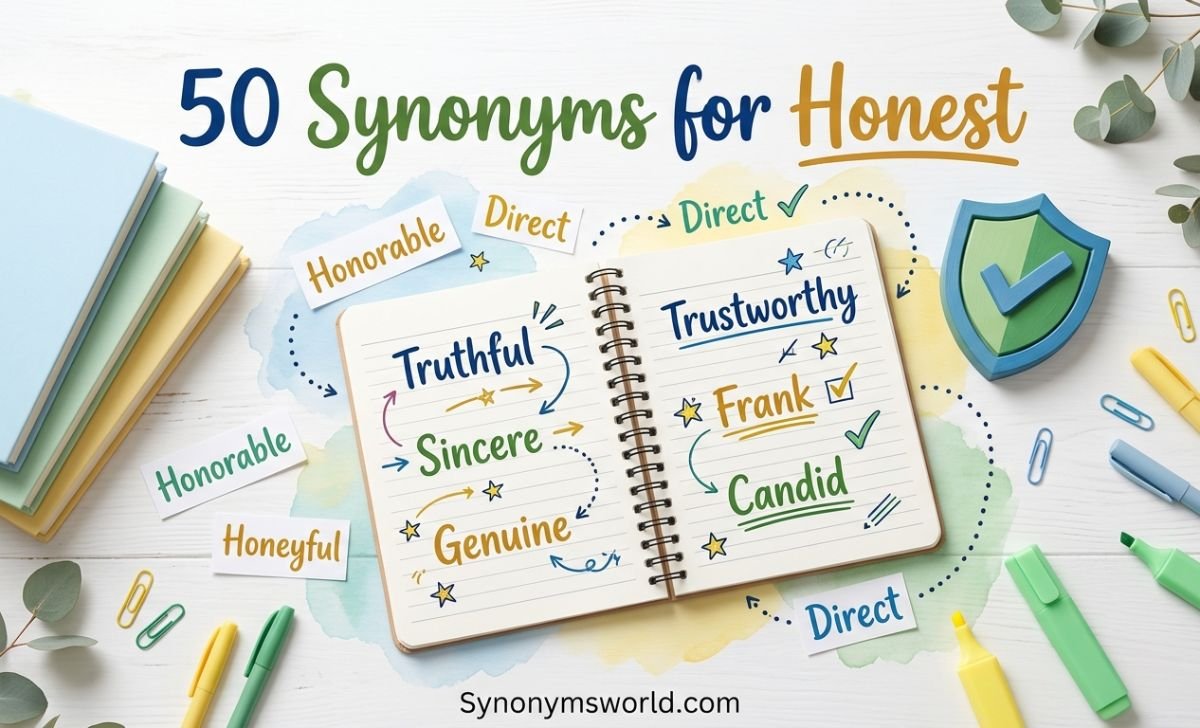
Finding the right synonyms for honest can make your writing more precise. Although words such as truthful, sincere, genuine, candid, trustworthy, and forthright are closely related, each one carries a slightly different meaning.
For example, a person who tells the truth is truthful, while someone who can be trusted with money or responsibilities is trustworthy.
A person who speaks openly may be candid, while someone whose actions match their values may be described as principled.
This guide covers 50 useful alternatives to honest, including words for people, communication, business, formal writing, and everyday conversation.
Quick Answer
Some of the best synonyms for honest are:
truthful, sincere, genuine, candid, frank, trustworthy, reliable, forthright, straightforward, transparent, honorable, upright, principled, authentic, open, direct, ethical, conscientious, honorable, and fair.
The best alternative depends on the exact meaning. Truthful focuses on telling the truth, sincere describes genuine feelings or intentions, and trustworthy suggests that someone can be relied upon.
What Does Honest Mean?
Honest describes someone who tells the truth, avoids cheating or deception, and behaves fairly. It can also describe information that is genuine and free from deliberate misrepresentation.
Examples:
- She is an honest person who always tells the truth.
- Give me your honest opinion.
- The company gave an honest explanation of the problem.
- He made an honest mistake.
The word can describe a person’s character, words, actions, opinions, intentions, or mistakes.
1. Truthful
Truthful means telling the truth and not giving false information.
It is one of the closest synonyms for honest, especially when talking about someone’s words.
Maria was always truthful about her work.
Best for: answers, statements, stories, and personal communication.
2. Sincere
Sincere describes genuine feelings, intentions, or words that are not meant to deceive.
He gave her a sincere apology.
It is particularly useful when discussing emotions and personal relationships.
Best for: apologies, feelings, praise, intentions, and expressions.
3. Genuine
Genuine means real, authentic, and not fake or artificial.
She showed genuine concern for her colleagues.
It can describe both people and their feelings.
Best for: emotions, kindness, interest, concern, and character.
4. Candid
Candid describes someone who speaks openly and directly, even when the truth may be uncomfortable.
The manager gave us a candid assessment of the project.
This word often suggests openness rather than simply factual accuracy.
Best for: opinions, interviews, feedback, discussions, and professional communication.
5. Frank
Frank means open and direct in expressing what you really think.
To be frank, I do not think the proposal is ready.
It is especially common when introducing an opinion.
Best for: conversations, opinions, criticism, and personal responses.
6. Trustworthy
Trustworthy describes someone who deserves confidence and can be relied upon to act properly.
Daniel is trustworthy, so I would feel comfortable giving him the responsibility.
Unlike truthful, this word focuses more on reliability and trust.
Best for: people, employees, friends, partners, and professionals.
7. Reliable
Reliable means dependable and consistent.
We need a reliable employee who can handle the position independently.
A reliable person may be honest, but the word also covers punctuality, responsibility, and consistency.
Best for: employees, friends, services, businesses, and responsibilities.
8. Forthright
Forthright means direct, open, and honest in speech or behavior.
The director was forthright about the company’s financial difficulties.
It has a professional tone and often suggests courage in saying something clearly.
Best for: business writing, leadership, feedback, and formal discussions.
9. Straightforward
Straightforward describes someone or something that is clear, direct, and without deception or unnecessary complexity.
She gave me a straightforward answer.
It can describe both communication and methods.
Best for: answers, explanations, instructions, and communication.
10. Transparent
Transparent means open and clear, especially about information, decisions, or processes.
The organization promised to be transparent about how donations were spent.
It is especially common in business, government, and professional communication.
Best for: policies, decisions, business practices, finances, and organizations.
11. Honorable
Honorable describes behavior that deserves respect because it follows strong moral standards.
He made the honorable decision to return the money.
This word focuses more on moral character than simply telling the truth.
Best for: actions, decisions, people, conduct, and principles.
12. Upright
Upright describes someone with strong moral standards who behaves properly.
Everyone regarded her as an upright and responsible leader.
It is more formal and often appears in discussions of character.
Best for: moral character, formal descriptions, and literature.
13. Principled
Principled means guided by strong moral beliefs.
She is a principled leader who refuses to compromise her values.
A principled person may be honest because their behavior follows a clear ethical standard.
Best for: leaders, professionals, decisions, and ethical behavior.
14. Authentic
Authentic means genuine and true to one’s real personality, beliefs, or values.
His speech felt authentic rather than carefully rehearsed.
It is useful when honesty means being genuine rather than pretending.
Best for: personalities, communication, brands, leadership, and personal expression.
15. Open
Open can describe someone who communicates freely and does not hide relevant information or feelings.
She was open about the challenges she faced.
The word often suggests willingness to communicate rather than complete truthfulness in every situation.
Best for: conversations, relationships, feelings, and workplace communication.
16. Direct
Direct describes speech or behavior that is clear and not indirect.
He was direct about what needed to change.
A direct person says what they mean without excessive hesitation.
Best for: opinions, instructions, feedback, and workplace communication.
17. Ethical
Ethical means consistent with accepted principles of right and wrong.
The company follows ethical business practices.
This is broader than honest because ethical behavior can involve fairness, responsibility, privacy, and other moral concerns.
Best for: business, professional conduct, decisions, and policies.
18. Conscientious
Conscientious describes someone who takes responsibilities seriously and tries to do what is right.
She is a conscientious employee who checks every detail carefully.
The word emphasizes responsibility and care rather than truth-telling alone.
Best for: employees, workers, students, professionals, and responsibilities.
19. Fair
Fair describes behavior that is just, reasonable, and free from unfair advantage.
The referee made a fair decision.
Someone can be fair without necessarily being completely honest, so this synonym works best when honest means impartial or just.
Best for: decisions, treatment, rules, negotiations, and judgments.
20. Just
Just means morally right or fair.
The judge tried to make a just decision.
It is a stronger fit when honesty involves fairness and moral judgment.
Best for: decisions, laws, treatment, and moral discussions.
21. Candidly Spoken
Candidly spoken refers to communication that expresses thoughts openly and without hiding the speaker’s real opinion.
She was candidly spoken about the difficulties facing the team.
It works particularly well when describing someone’s communication style.
Best for: opinions, interviews, feedback, and discussions.
22. Unbiased
Unbiased means free from personal favoritism or prejudice.
The review provides an unbiased assessment of both products.
This is not a direct synonym in every context, but it fits when honest means giving a fair and impartial assessment.
Best for: reviews, reports, journalism, research, and evaluations.
23. Impartial
Impartial means treating different people or sides fairly without favoring one.
The mediator remained impartial throughout the discussion.
It is more formal than fair.
Best for: judges, mediators, decisions, reports, and professional settings.
24. Unvarnished
Unvarnished describes information presented plainly, without making it seem better than it really is.
The report gave an unvarnished account of the company’s problems.
It often carries the idea of uncomfortable but realistic truth.
Best for: truth, facts, reports, criticism, and assessments.
25. Blunt
Blunt means very direct, sometimes without trying to soften the message.
His blunt response surprised everyone.
Unlike candid, it can sound negative because blunt speech may seem insensitive.
Best for: strong opinions, criticism, and direct conversations.
26. Veracious
Veracious means truthful or accurate.
The historian relied on veracious accounts of the event.
It is uncommon in everyday conversation but useful in formal or literary writing.
Best for: formal writing, historical discussion, and academic contexts.
27. Truthful-Minded
Truthful-minded suggests a strong commitment to truth and honesty.
She is a truthful-minded person who dislikes deception.
This expression is less common than truthful but can work in descriptive writing.
Best for: character descriptions and literary contexts.
28. Aboveboard
Aboveboard means completely open, legal, and honest.
The negotiations were conducted in an aboveboard manner.
It is especially useful for business dealings and transactions.
Best for: business, negotiations, agreements, and financial matters.
29. Clean
Clean can describe a person’s record or conduct when there is no dishonesty, corruption, or wrongdoing involved.
He has a clean record and a strong professional reputation.
This is a context-dependent synonym rather than a direct replacement for honest.
Best for: records, conduct, reputations, and business dealings.
30. Trustable
Trustable means capable of being trusted.
The information came from a trustable source.
However, trustworthy or reliable is usually more natural in modern English.
Best for: limited contexts where the focus is on trust.
31. Dependable
Dependable describes someone who can be counted on to do what is expected.
She is a dependable colleague who always meets deadlines.
The word is closely related to trustworthy, but it emphasizes reliability.
Best for: people, workers, colleagues, friends, and services.
32. Good-Faith
Good-faith describes actions or intentions that are sincere and made without an intention to deceive.
They made a good-faith effort to resolve the disagreement.
This term is common in legal, business, and professional contexts.
Best for: efforts, negotiations, agreements, and intentions.
33. Sincere-Hearted
Sincere-hearted describes someone whose feelings and intentions are genuine.
She is a sincere-hearted person who genuinely cares about others.
It has a warm and somewhat literary tone.
Best for: personal descriptions, emotional writing, and relationships.
34. Earnest
Earnest means serious, sincere, and genuine in intention.
He made an earnest attempt to correct the mistake.
It is useful when honesty is connected with serious intention.
Best for: efforts, requests, promises, and intentions.
35. Unfeigned
Unfeigned means genuine and not pretended.
She expressed unfeigned gratitude for their support.
It is formal and often used in polished writing.
Best for: gratitude, emotions, reactions, and formal prose.
36. Unaffected
Unaffected can describe behavior or feelings that are natural rather than artificial or deliberately performed.
His response was calm and unaffected.
It can suggest authenticity, although it is not always a direct synonym for honest.
Best for: behavior, reactions, personality, and emotional expression.
37. Real
Real is an informal way to describe someone or something genuine and sincere.
She is a real person who does not pretend to be perfect.
It is common in everyday speech.
Best for: personality, relationships, feelings, and casual conversation.
38. Sincere-Minded
Sincere-minded suggests a person who approaches situations with genuine intentions.
He is sincere-minded and genuinely wants to help.
This expression is less common than sincere, so it is better suited to descriptive writing.
Best for: character descriptions and personal writing.
39. Straight
Straight can mean direct and truthful in informal English.
Give me a straight answer.
It is especially natural in phrases such as straight answer, straight talk, and straight with someone.
Best for: casual conversation and direct communication.
40. Plainspoken
Plainspoken describes someone who speaks simply, directly, and without hiding their meaning.
Her plainspoken style made her easy to understand.
It often carries a positive sense of clarity and openness.
Best for: speech, writing style, personalities, and public communication.
41. Matter-of-Fact
Matter-of-fact describes communication that is straightforward and unemotional.
He gave a matter-of-fact explanation of what happened.
It can overlap with honest communication when the focus is on plain, objective expression.
Best for: explanations, reports, statements, and professional communication.
42. Unreserved
Unreserved can describe someone who expresses feelings or opinions freely rather than holding them back.
She was unreserved in her praise of the team.
It is useful when openness is the main idea.
Best for: praise, opinions, emotions, and communication.
43. Uncompromising
Uncompromising describes someone who refuses to abandon their principles.
He was uncompromising about maintaining professional standards.
It can relate to honesty when someone refuses to compromise ethical values.
Best for: principles, standards, ethics, and leadership.
44. Moral
Moral describes behavior based on principles of right and wrong.
She has a strong moral character.
It is broader than honest, but it works when discussing honesty as part of someone’s ethical character.
Best for: character, behavior, values, and ethical discussions.
45. Virtuous
Virtuous means having or showing high moral standards.
The story portrays him as a virtuous and compassionate leader.
It is stronger and more formal than honest.
Best for: character descriptions, literature, morality, and formal writing.
46. Righteous
Righteous describes someone who behaves according to strong moral principles.
He believed he was defending a righteous cause.
The word can sometimes sound highly moralistic, so context matters.
Best for: moral arguments, literature, religion-related writing, and formal descriptions.
47. Incorruptible
Incorruptible describes someone who cannot easily be persuaded to act dishonestly or accept improper benefits.
The investigator was known for being incorruptible.
It is a particularly strong word for someone whose principles cannot be bought.
Best for: officials, leaders, investigators, professionals, and public service.
48. Upright-Acting
Upright-acting describes behavior that appears morally proper and honorable.
His upright-acting nature earned the respect of his community.
This is uncommon in everyday English and should generally be replaced by upright or principled in polished writing.
Best for: descriptive or literary contexts.
49. Trustworthy-Hearted
Trustworthy-hearted suggests a person whose character inspires confidence.
She is trustworthy-hearted and always looks after her friends.
This is an uncommon expression and is more suitable for creative or personal writing than formal English.
Best for: personal descriptions and creative writing.
50. Straightforward-Hearted
Straightforward-hearted suggests someone who is open, genuine, and uncomplicated in their intentions.
He is straightforward-hearted and never tries to manipulate people.
Like several literary expressions in this list, it is not a standard everyday replacement for honest.
Best for: creative descriptions and informal character writing.
Synonyms for an Honest Person
When describing a person, the strongest natural choices are:
- Truthful — tells the truth.
- Sincere — has genuine feelings or intentions.
- Trustworthy — deserves confidence.
- Reliable — can be depended upon.
- Candid — speaks openly.
- Forthright — direct and honest.
- Principled — follows strong moral values.
- Upright — has strong moral character.
- Genuine — authentic and not fake.
- Honorable — worthy of respect because of good conduct.
For everyday writing, truthful, trustworthy, sincere, genuine, and reliable are usually more natural than rare words such as veracious or incorruptible.
Another Word for Honesty and Integrity
If you want a word that combines the ideas of honesty and strong moral character, integrity is one of the best choices.
Other possibilities include:
- uprightness
- morality
- principle
- honor
- ethical conduct
- trustworthiness
- good character
- rectitude
Integrity is especially useful in professional writing because it suggests that a person’s actions match their values.
Her integrity earned the trust of the entire team.
Very Honest Synonyms
When you want to emphasize a high level of honesty, these expressions can work:
- completely truthful
- utterly sincere
- deeply principled
- highly trustworthy
- forthright
- candid
- open and direct
- aboveboard
- incorruptible
- uncompromising
The right expression depends on what kind of honesty you mean. Incorruptible is particularly strong for someone who cannot be persuaded to act dishonestly, while candid is better for unusually open communication.
Another Way to Say “To Be Honest”
The phrase to be honest is common in conversation, but formal writing may call for a more precise expression.
Alternatives include:
- frankly
- honestly
- to speak frankly
- in all honesty
- to be candid
- truthfully
- to tell the truth
- in my view
- speaking plainly
- to give you my honest opinion
Examples:
To be honest, I disagree with the proposal.
Frankly, I disagree with the proposal.
To be candid, I do not think the plan is ready.
For an academic essay, it is often better to state the actual argument instead of beginning with to be honest.
Another Word for “To Be Honest” in an Essay
In an essay, to be honest can sound conversational. More polished alternatives include:
- In fact
- Notably
- Clearly
- In my assessment
- From this perspective
- More importantly
- It is reasonable to argue that
- The evidence suggests that
The best replacement depends on the sentence. An academic essay should communicate the argument directly rather than simply replacing to be honest with another conversational phrase.
When to Use Honest and Truthful
Honest is a good choice when describing someone’s character or actions. Truthful fits especially well when talking about whether a statement matches the facts.
For example, an honest employee follows ethical standards and does not cheat customers. A truthful answer gives accurate information about a situation.
Both words can describe a person who tells the truth. The difference is in the focus: honest often relates to integrity and conduct, while truthful emphasizes accuracy in what someone says or reports.
Honest vs Sincere
Honest focuses on truth and lack of deception.
Sincere focuses on genuine feelings or intentions.
He was honest about his mistake.
She gave a sincere apology.
An apology can be sincere because the speaker genuinely regrets what happened. Honesty is more concerned with whether the person is being truthful.
Honest vs Trustworthy
Honest means someone does not deliberately lie or deceive.
Trustworthy means someone can be relied upon and trusted.
Mark is honest about his mistakes.
Mark is trustworthy with confidential information.
A trustworthy person may possess many qualities beyond honesty, including reliability, responsibility, and discretion.
Honest vs Candid
Candid means openly expressing what you really think, especially when the information may be difficult to hear.
She was candid about the team’s weaknesses.
Honest is broader and can describe general character or conduct.
She is an honest employee.
Honest vs Transparent
Transparent is commonly associated with openness about processes, decisions, information, or finances.
The company was transparent about its pricing.
Honest can describe the people or behavior involved.
The company gave an honest explanation.
In business writing, transparent is often the more precise term when discussing openness.
Honest Antonyms
The opposite of honest can vary according to context.
Common antonyms include:
- dishonest
- deceitful
- deceptive
- untruthful
- lying
- fraudulent
- insincere
- misleading
- corrupt
- duplicitous
- two-faced
- dishonorable
For a person, dishonest, deceitful, or untrustworthy may be appropriate.
For information, false, misleading, or inaccurate may fit better.
Honest Words for Business and Professional Writing
In professional communication, the strongest alternatives depend on the situation.
Transparent works well for company policies and decision-making.
Forthright suits direct professional communication.
Trustworthy describes people, companies, and services that inspire confidence.
Ethical focuses on proper professional conduct.
Aboveboard is useful for legitimate and open business dealings.
Candid works particularly well for feedback, reviews, and assessments.
Examples:
We believe in transparent communication with our customers.
The manager gave a candid assessment of the results.
The company has built a trustworthy reputation.
The negotiations were completely aboveboard.
How to Describe an Honest Person
An honest person can be described as someone who:
- tells the truth even when it is difficult
- accepts responsibility for mistakes
- keeps promises
- avoids deception
- treats people fairly
- communicates openly
- respects other people’s trust
- follows strong personal values
Depending on the quality you want to emphasize, truthful, sincere, trustworthy, principled, dependable, candid, or forthright may be more precise than simply saying honest.
FAQs
1. What is the best synonym for honest?
Truthful is one of the closest synonyms when you mean someone who tells the truth. Other strong choices include sincere, genuine, trustworthy, candid, forthright, and straightforward.
2. What is another word for an honest person?
Good choices include truthful, trustworthy, sincere, genuine, reliable, principled, upright, honorable, and forthright.
3. What is a strong word for very honest?
Forthright, candid, aboveboard, principled, and incorruptible can express strong forms of honesty, depending on the context.
4. What is the opposite of honest?
Common opposites include dishonest, deceitful, deceptive, untruthful, fraudulent, insincere, and untrustworthy.
5. What is another word for honesty and integrity?
Integrity is the strongest single word for the combination of honesty and strong moral character. Uprightness, honor, morality, and principle can also fit.
6. What is a synonym for honest opinion?
Candid opinion, frank opinion, genuine opinion, and straightforward opinion can work depending on the tone.
7. What is another way to say “to be honest”?
Common alternatives include frankly, honestly, in all honesty, to be candid, and to speak frankly.
8. What is a formal way to say “to be honest”?
In formal writing, expressions such as to be candid, frankly, or in my assessment may work, although directly presenting the argument is often stronger.
9. Is truthful the same as honest?
They are closely related but not identical. Truthful mainly concerns telling the truth, while honest can also describe moral behavior, fairness, and a person’s overall character.
10. Is sincere a synonym for honest?
Sometimes. Sincere means genuine in feelings or intentions, while honest focuses more strongly on truthfulness and lack of deception.
Conclusion
The best synonyms for honest depend on the quality you want to highlight. Truthful is ideal for someone who tells the truth, while sincere emphasizes genuine feelings and trustworthy focuses on reliability.
Candid, frank, and forthright work well for direct communication, whereas principled, upright, honorable, and ethical describe strong moral character.
For professional writing, transparent, trustworthy, ethical, and aboveboard can add useful precision. In everyday conversation, simpler words such as genuine, truthful, reliable, and straightforward usually sound more natural.
Rather than replacing honest automatically, consider the exact meaning of the sentence. The most effective synonym is the one that communicates the specific kind of honesty you intend.
Read More Blogs: