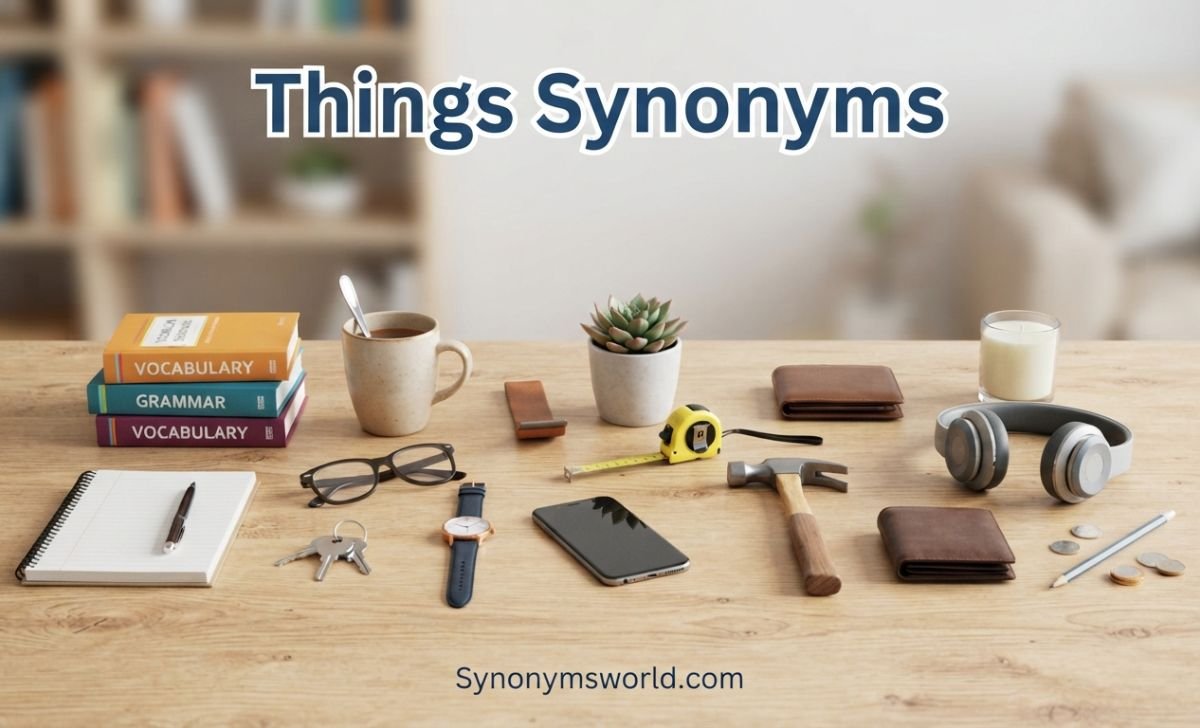
Things is one of the most useful words in everyday English, but it can also be one of the vaguest. We use it for physical objects, personal belongings, tasks, ideas, problems, topics, products, and situations.
That flexibility is helpful when speaking casually. In writing, however, a more specific word can make your meaning much clearer.
For example, “I have many things to do” could mean tasks, duties, or activities. “Take your things with you” might mean belongings or possessions. In a business context, “the things we sell” would be more naturally described as products, goods, or merchandise.
So, the best synonym for things depends on what you actually mean.
Quick Answer
Some of the most useful alternatives to things include:
items, objects, stuff, belongings, possessions, goods, articles, matters, issues, elements, aspects, details, points, factors, topics, subjects, ideas, concepts, concerns, problems, challenges, tasks, duties, activities, events, situations, components, parts, features, contents, equipment, gear, tools, devices, products, merchandise, property, materials, effects, and particulars.
There is no single replacement that works in every sentence. Items is useful for individual objects, belongings for personal property, matters for subjects or concerns, and tasks for work that needs to be completed.
1. Items
Items is one of the closest alternatives to things when you mean separate objects that can be identified, counted, listed, bought, or sold.
Example: Please put all the items on the table.
It works especially well in shopping lists, inventories, instructions, and business writing.
2. Objects
Objects normally refers to physical things that can be seen or touched.
Example: The museum displayed several ancient objects.
Use objects when the physical nature of the thing matters.
3. Stuff
Stuff is a casual word for an unspecified collection of things.
Example: I need to move my stuff before the guests arrive.
It sounds natural in conversation but is usually less suitable when precise or formal writing is required.
4. Belongings
Belongings means things that belong to a person.
Example: She packed her belongings before moving to another city.
It is a natural choice for clothes, bags, books, electronics, and other personal property.
5. Possessions
Possessions refers to things owned by a person.
Example: He kept his most valuable possessions in a safe.
It can sound slightly more formal than belongings and places emphasis on ownership.
6. Goods
Goods refers to products that are made, bought, sold, or transported.
Example: The company exports agricultural goods.
This word is common in business, trade, economics, and logistics.
7. Articles
Articles can mean individual objects, especially in formal, commercial, or legal contexts.
Example: The store sells household articles.
In everyday conversation, items is usually more natural.
8. Matters
Matters works when things means subjects, concerns, or situations that require attention.
Example: We need to discuss several important matters.
It is particularly useful in professional, official, and formal communication.
9. Affairs
Affairs can describe matters, activities, or situations connected with a person, organization, or country.
Example: She manages the company’s financial affairs.
Common expressions include personal affairs, business affairs, and international affairs.
10. Issues
Issues refers to problems, concerns, or subjects that need attention or discussion.
Example: The meeting focused on several workplace issues.
It is not a general replacement for physical objects; it works when things has an abstract meaning.
11. Elements
Elements means individual parts that combine to create something larger.
Example: Trust and communication are important elements of a strong relationship.
It is particularly useful in analytical and academic writing.
12. Aspects
Aspects refers to particular parts, sides, or features of a subject.
Example: The study examines the social and economic aspects of the problem.
It is a strong choice when discussing different parts of a broad topic.
13. Details
Details means specific pieces of information.
Example: Please send me the details of the meeting.
Use it when things means facts, information, or particulars.
14. Points
Points can refer to individual ideas, arguments, or subjects raised in a discussion.
Example: She made several useful points during the presentation.
It works naturally in meetings, essays, debates, and explanations.
15. Factors
Factors are conditions or influences that affect a result.
Example: Cost and location were important factors in our decision.
This is more precise than things when you are discussing causes or influences.
16. Topics
Topics means subjects that people discuss, study, teach, or write about.
Example: The course covers several important topics.
It is common in education, journalism, blogging, and everyday conversation.
17. Subjects
Subjects can refer to areas of study or matters being discussed.
Example: History was one of my favorite subjects at school.
It can also describe a topic under consideration.
18. Ideas
Ideas refers to thoughts, suggestions, plans, or opinions.
Example: She shared several ideas for improving the website.
Choose ideas when the “things” you mean exist mainly as thoughts or suggestions.
19. Concepts
Concepts are general or abstract ideas.
Example: Students often find these scientific concepts difficult at first.
This word fits academic, educational, scientific, and technical writing.
20. Notions
Notions means ideas or beliefs, often general or loosely formed.
Example: He rejected the notion that success happens overnight.
It is less common in casual conversation than ideas.
21. Concerns
Concerns refers to matters that cause worry or require attention.
Example: Safety concerns delayed the opening of the building.
It is useful when the speaker wants to highlight something that needs consideration.
22. Problems
Problems means difficulties that need to be solved.
Example: The team identified several problems with the old system.
When “things” are clearly negative difficulties, problems is much more direct.
23. Challenges
Challenges refers to difficult situations that require effort or skill.
Example: Starting a new business comes with many challenges.
Unlike problems, the word can also suggest an opportunity to improve.
24. Difficulties
Difficulties means problems or circumstances that make something harder to accomplish.
Example: We experienced several difficulties during the journey.
It works well in both personal writing and formal reports.
25. Tasks
Tasks are individual pieces of work that need to be completed.
Example: I have three tasks left on my list.
Instead of saying “I have many things to do,” tasks immediately makes the meaning clearer.
26. Duties
Duties means responsibilities or jobs someone is expected to perform.
Example: Her duties include training new employees.
It is particularly appropriate for employment, official roles, and responsibilities.
27. Activities
Activities refers to things people do or take part in.
Example: The children enjoyed several outdoor activities.
It works well for hobbies, school programs, exercise, travel, and recreation.
28. Actions
Actions means things that someone does.
Example: His actions had a positive effect on the team.
This word is useful when the focus is on behavior or conduct.
29. Events
Events are things that happen, especially notable, planned, or organized occasions.
Example: Several important events shaped the country’s history.
Use events when “things” refers to happenings rather than objects.
30. Occurrences
Occurrences means events or incidents that happen.
Example: The report documents unusual occurrences in the area.
It sounds more formal than events and is common in reports and technical contexts.
31. Experiences
Experiences refers to events or situations that someone personally lives through.
Example: Traveling alone gave her valuable experiences.
It works especially well for travel, education, work, and personal development.
32. Circumstances
Circumstances means the conditions surrounding a person, event, or situation.
Example: Under these circumstances, delaying the decision was sensible.
It is useful when the surrounding conditions are important to the meaning.
33. Situations
Situations refers to particular sets of circumstances.
Example: He stays calm in difficult situations.
It is a natural alternative when things means a condition or state of affairs.
34. Conditions
Conditions refers to circumstances that affect a person, place, activity, or situation.
Example: Working conditions have improved significantly.
The word is common in discussions about employment, weather, health, agreements, and environments.
35. Components
Components are separate parts that make up a larger system or product.
Example: The technician replaced two damaged components.
This is especially useful in technical, engineering, and computer-related writing.
36. Parts
Parts means sections or pieces that make up something larger.
Example: We ordered replacement parts for the machine.
It is simple, natural, and useful in both everyday and technical English.
37. Features
Features are noticeable or important qualities, characteristics, or parts of something.
Example: The latest phone has several useful features.
It is common when describing products, software, websites, buildings, and services.
38. Particulars
Particulars means specific facts or details about something.
Example: The contract contains all the necessary particulars.
This is a more formal choice and often appears in legal or administrative writing.
39. Contents
Contents refers to everything contained inside something.
Example: She checked the contents of the box before signing the form.
It works well for boxes, bags, documents, books, containers, and packages.
40. Equipment
Equipment means tools, machines, or physical items needed for a particular activity.
Example: The laboratory has modern equipment.
Remember that equipment is normally uncountable. We say some equipment or pieces of equipment, not “equipments.”
41. Gear
Gear is an informal word for equipment, clothing, or tools used for a particular activity.
Example: We packed our hiking gear before leaving.
It is common in conversations about sports, camping, travel, fishing, and outdoor activities.
42. Tools
Tools are objects used to perform a particular job or task.
Example: Keep your tools in the garage.
The word can also be used figuratively, such as tools for learning or tools for communication.
43. Devices
Devices are objects or pieces of equipment designed for a particular purpose.
Example: The clinic uses advanced medical devices.
This word is especially useful for technology, electronics, medicine, and engineering.
44. Products
Products are goods made or offered for sale.
Example: The company launched three new products this year.
Use this instead of things when talking about what a business makes or sells.
45. Merchandise
Merchandise means goods offered for sale.
Example: The store receives new merchandise every Friday.
It is common in retail, e-commerce, marketing, and commercial writing.
46. Property
Property can refer to things owned by a person or organization.
Example: The police returned the stolen property.
The word can also mean land or buildings, so context determines the meaning.
47. Effects
Effects can mean a person’s personal possessions, particularly in formal expressions.
Example: The traveler kept her personal effects in one bag.
The phrase personal effects is common in official, legal, and administrative contexts.
48. Chattels
Chattels is a formal legal term for movable personal property.
Example: The agreement listed the owner’s chattels.
This is not a common everyday synonym. It is mainly useful in legal, historical, or specialized contexts.
49. Paraphernalia
Paraphernalia refers to a collection of equipment, objects, or accessories associated with a particular activity.
Example: The photographer arrived with all his camera paraphernalia.
It often suggests a collection of related items rather than one specific object.
50. Materials
Materials refers to substances, supplies, or resources used to make something or complete a task.
Example: The teacher prepared the materials for the science experiment.
It is a good choice when things means supplies or resources.
Things Synonyms for Formal Writing
In formal writing, replacing things is useful when the word makes your sentence vague. The best alternative depends on the exact meaning.
| Instead of “things” | Better choice | Example |
|---|---|---|
| Things to discuss | Matters / issues | We discussed several important matters. |
| Things to consider | Factors / aspects | Several factors affected the result. |
| Things in a box | Contents / items | Check the contents of the box. |
| Things you own | Possessions / belongings | Keep your belongings safe. |
| Things a company sells | Products / goods | The company exports goods. |
| Things to complete | Tasks | Several tasks remain. |
| Things that influence a result | Factors | Several factors affect demand. |
| Things in a system | Components / elements | The system has several components. |
| Things you learn | Concepts / ideas | Students learn new concepts. |
| Things that cause concern | Issues / concerns | The report identifies several concerns. |
The goal is precision, not simply choosing a more complicated word.
Things Synonyms for Essays and Academic Writing
Academic writing usually becomes stronger when vague nouns are replaced with words that identify the exact idea.
Instead of:
There are many things that affect student performance.
Write:
Several factors affect student performance.
Instead of:
The article discusses many things about social media.
Write:
The article examines several aspects of social media.
Instead of:
Students learn many things in school.
Write:
Students develop knowledge, skills, and critical-thinking abilities in school.
This does not mean you must remove things from every essay. Sometimes it is the most natural choice. The important point is to avoid using it when a more accurate noun is available.
Things Synonyms for Business English
Professional communication becomes clearer when you name the exact subject instead of relying on the broad word things.
For general business concerns, matters fits naturally:
We will discuss the matter tomorrow.
When the subject involves problems that need attention, issues is more precise:
The team resolved several technical issues.
For entries on a list, items is the natural choice:
The agenda contains five items.
When talking about what a company makes or sells, products is more appropriate:
Our latest products are now available.
For important areas that need attention or action, priorities works well:
Customer service remains one of our main priorities.
Choosing the noun that matches the situation makes emails, reports, presentations, and workplace communication clearer and more professional.tand.
Things vs Stuff
Things and stuff can both refer to unspecified objects, but stuff is more informal.
I need to pack my things.
I need to pack my stuff.
Both sound natural in conversation. However, stuff usually suggests an uncounted collection, while things has a much wider range of meanings.
For formal writing, a more specific noun is usually preferable.
Things vs Items
Items is one of the closest alternatives to things, but it is more precise.
There are several things on the table.
There are several items on the table.
The second sentence suggests separate objects that can be identified or counted.
That makes items particularly useful for shopping lists, inventories, instructions, forms, and business documents.
Things vs Objects
Objects generally means physical entities.
The room contained several unusual objects.
But things can refer to much more than physical objects:
We need to discuss several things.
Those “things” could be ideas, problems, plans, or topics. Therefore, objects is not a universal replacement.
Things vs Belongings
Belongings specifically means things that a person owns.
Please collect your things.
Please collect your belongings.
The second sentence clearly communicates the idea of personal property.
For luggage, clothes, books, electronics, and similar possessions, belongings is often more precise than things.
Common Mistakes When Replacing Things
One common mistake is choosing a synonym simply because it sounds more advanced.
For example:
We discussed several objects during the meeting.
This sounds wrong if the meeting was about plans or problems. Matters, topics, or issues would be more appropriate.
Another mistake is using stuff in formal writing:
The report explains several stuff about the project.
This is incorrect because stuff is uncountable and the sentence needs a different construction.
A better version would be:
The report explains several aspects of the project.
The best synonym should always match the meaning and grammar of the original sentence.
FAQs
1. What is the best synonym for things?
There is no single best synonym. Items, objects, stuff, belongings, matters, issues, aspects, and details are useful choices depending on context.
2. What is another word for things in an essay?
Good choices include aspects, factors, elements, issues, concepts, topics, points, and details, depending on what you are describing.
3. What is a formal word for things?
Depending on the context, matters, items, aspects, elements, factors, particulars, possessions, and objects can work well.
4. What is a casual synonym for things?
Stuff is the most common casual alternative.
5. What is another word for things you own?
Use belongings, possessions, property, personal effects, or personal items.
6. Are things and stuff the same?
They can have the same meaning when referring to unspecified objects, but stuff is generally more informal and is normally uncountable.
7. What is the difference between things and items?
Things has a broader meaning, while items usually refers to individual objects, products, or entries that can be identified or counted.
8. What is the difference between things and objects?
Objects normally refers to physical things. Things can also refer to ideas, activities, events, problems, and situations.
9. What is a professional synonym for things?
There is no universal professional replacement. Depending on the meaning, use items, matters, issues, products, aspects, factors, components, or details.
10. What is a synonym for things to do?
Depending on the sentence, use tasks, activities, duties, responsibilities, errands, or actions.
11. What is a synonym for things in business?
Useful alternatives include items, products, goods, merchandise, matters, issues, concerns, priorities, and components.
12. How can I avoid using things in writing?
First identify what things means in your sentence. Then choose the specific noun that describes it, such as tasks for work, factors for influences, issues for problems, or items for objects.
Final Thoughts
Things is not a bad word. Its flexibility is exactly why it is so common in everyday English. The problem comes when a vague word hides information that the reader needs.
Use items or objects for physical things, belongings or possessions for personal property, and goods, products, or merchandise for things sold by a business.
For subjects and concerns, matters, issues, topics, or subjects may be clearer. For work, tasks and duties usually communicate more than the vague phrase “things to do.”
A good synonym is not necessarily the most formal word. It is the word that fits the meaning naturally and makes your sentence clearer.