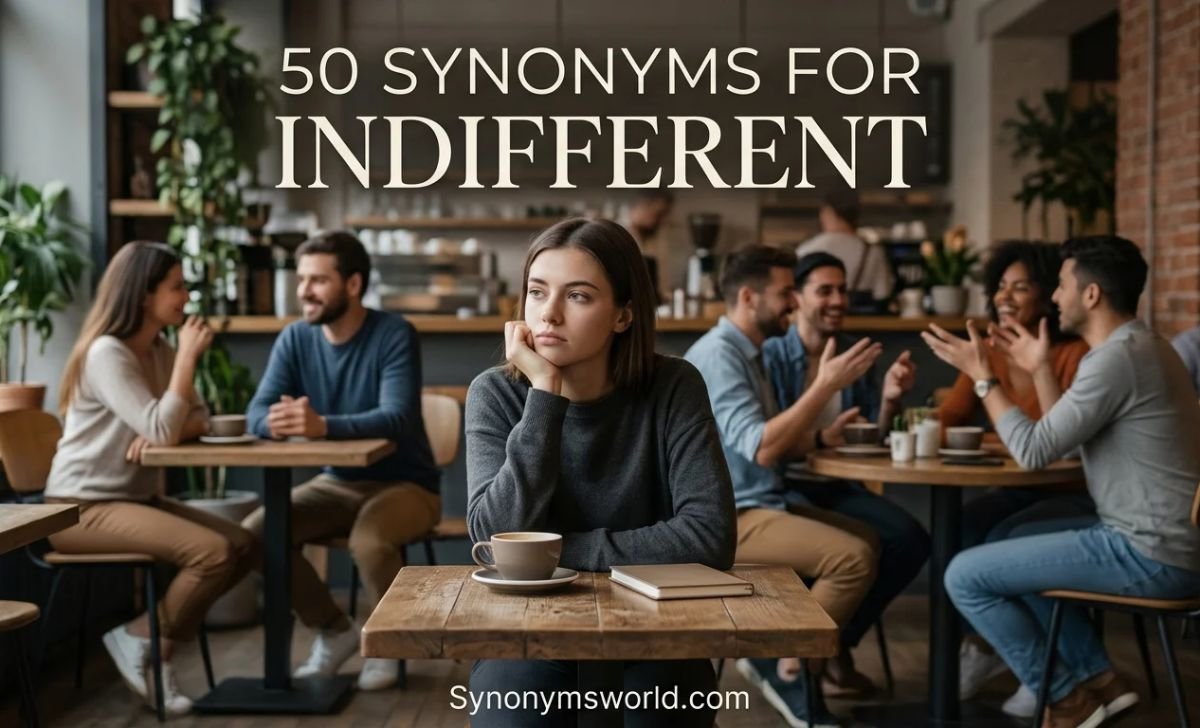
Have you ever wanted to describe someone who does not seem to care, but felt that indifferent was not the right word? The best alternative depends on the situation.
A person may be uninterested in a topic, unconcerned about a problem, or apathetic toward other people’s struggles.
These words are related, but they do not mean exactly the same thing. This guide covers 50 synonyms for indifferent with simple meanings and natural examples.
You will also learn which words fit everyday conversations, formal writing, relationships, and situations where indifference describes a lack of interest rather than poor quality.
Quick Answer
The best synonyms for indifferent include uninterested, unconcerned, apathetic, uncaring, detached, nonchalant, neutral, and unenthusiastic.
Use uninterested when someone lacks interest, unconcerned when they do not worry, and apathetic when they show little emotion or motivation.
The right choice depends on the context.
What Does Indifferent Mean?
Indifferent means having little or no interest, concern, or emotional response toward someone or something. It can describe a person’s attitude, feelings, or lack of preference.
For example, if you are indifferent to a movie, you have no strong feelings about watching it. If someone seems indifferent to a serious problem, they may appear unconcerned or emotionally detached.
The word can also describe a lack of preference between options. However, it does not always mean that someone is rude or unkind. Context helps readers understand the intended meaning.
50 Synonyms for Indifferent
The words below are grouped by their closest meanings. Some are direct alternatives, while others fit only specific situations. Choose the word that matches the exact idea you want to express.
1. Apathetic
Meaning: Showing little interest, emotion, or motivation.
- The students seemed apathetic about the school election.
- He grew apathetic after months of repeated delays.
2. Unconcerned
Meaning: Not worried or troubled about something.
- She remained unconcerned about the minor delay.
- He seemed unconcerned about the approaching deadline.
3. Uninterested
Meaning: Not wanting to learn about, watch, or take part in something.
- I was uninterested in the long debate.
- The child looked uninterested during the lecture.
4. Uncaring
Meaning: Showing little concern for other people’s needs or feelings.
- His uncaring response upset his friend.
- An uncaring manager may ignore staff concerns.
5. Detached
Meaning: Emotionally separate from a person or situation.
- The doctor stayed detached while explaining the results.
- She sounded detached when discussing the argument.
6. Aloof
Meaning: Distant or unfriendly in the way someone behaves.
- His aloof manner made introductions difficult.
- She appeared aloof at the family gathering.
7. Nonchalant
Meaning: Calm and unconcerned, even when others expect a stronger reaction.
- He gave a nonchalant shrug after missing the bus.
- She sounded nonchalant about the unexpected change.
8. Unenthusiastic
Meaning: Showing little excitement or interest.
- The team gave an unenthusiastic response to the plan.
- He sounded unenthusiastic about joining the club.
9. Unmoved
Meaning: Not emotionally affected or persuaded by something.
- She remained unmoved by his apology.
- The audience seemed unmoved by the speech.
10. Impassive
Meaning: Showing little or no emotion on the face or in the voice.
- The judge remained impassive during the hearing.
- His impassive expression revealed little about his thoughts.
11. Dispassionate
Meaning: Calm and not guided by strong emotions.
- The editor gave a dispassionate review of the report.
- A dispassionate discussion helped the group compare both proposals.
12. Unresponsive
Meaning: Not reacting or replying when a response is expected.
- He remained unresponsive to several messages.
- The audience was unresponsive to the speaker’s questions.
13. Unfeeling
Meaning: Seeming to lack sympathy or emotional warmth.
- His unfeeling remark hurt her deeply.
- The character appeared unfeeling toward the suffering around him.
14. Insensitive
Meaning: Not considering how words or actions may affect others.
- That insensitive comment embarrassed her.
- He was insensitive to his colleague’s concerns.
15. Unsympathetic
Meaning: Not showing understanding or compassion for another person’s difficulties.
- The manager was unsympathetic to the employee’s situation.
- She found the response unsympathetic and dismissive.
16. Emotionally Distant
Meaning: Not showing much emotional closeness or openness.
- He had become emotionally distant from his friends.
- Her emotionally distant manner made an honest conversation difficult.
17. Uninvolved
Meaning: Not taking part in an activity or situation.
- He stayed uninvolved in the office dispute.
- Several parents felt uninvolved in the school’s decisions.
18. Disengaged
Meaning: Not actively interested, involved, or attentive.
- The audience became disengaged during the lengthy presentation.
- She felt disengaged from the project after the goals changed.
19. Unbothered
Meaning: Not upset or worried about something.
- He seemed unbothered by the criticism.
- She remained unbothered when the plans changed.
20. Blasé
Meaning: Unimpressed or bored because something feels familiar or ordinary.
- He was blasé about meeting another celebrity.
- After years of travel, she seemed blasé about airport delays.
21. Insouciant
Meaning: Relaxed and unconcerned, sometimes in a way that seems careless.
- His insouciant attitude surprised the nervous team.
- She gave an insouciant smile before the interview.
22. Phlegmatic
Meaning: Calm and not easily excited or upset.
- His phlegmatic nature helped during the crisis.
- She remained phlegmatic while others argued.
23. Stoic
Meaning: Enduring pain or difficulty without showing much emotion.
- He stayed stoic while discussing the setback.
- Her stoic response hid how difficult the experience had been.
Note: Stoic usually describes emotional self-control, not a lack of interest.
24. Passive
Meaning: Not taking action or showing much initiative.
- He took a passive role in the group discussion.
- A passive response allowed the disagreement to continue.
25. Listless
Meaning: Lacking energy, enthusiasm, or interest.
- She felt listless after a sleepless night.
- The players looked listless during the second half.
26. Cool
Meaning: Calm and emotionally controlled, sometimes appearing distant.
- He stayed cool during the heated discussion.
- Her cool response made it hard to tell whether she agreed.
Note: Cool has several meanings. It fits only when describing a calm or emotionally distant manner.
27. Distant
Meaning: Not showing warmth, closeness, or much emotional connection.
- He seemed distant after their disagreement.
- Her distant tone suggested that something was wrong.
28. Withdrawn
Meaning: Quiet and less willing to interact with others.
- He became withdrawn after moving to a new school.
- She seemed withdrawn during the family dinner.
29. Noncommittal
Meaning: Not clearly expressing an opinion, decision, or promise.
- He gave a noncommittal answer about the offer.
- Her noncommittal reply left the team unsure of her plans.
30. Neutral
Meaning: Not favoring either side or expressing a strong preference.
- The moderator remained neutral during the debate.
- I am neutral about which restaurant we choose.
Note: Neutral often means impartial or without a preference. It does not necessarily mean uncaring.
31. Impartial
Meaning: Fair and not favoring one person or side over another.
- The referee remained impartial throughout the match.
- An impartial review considered evidence from both teams.
Note: Impartial is about fairness, not a lack of emotion or interest. Use it when neutrality is the intended meaning.
32. Disinterested
Meaning: Not personally involved or motivated by personal gain; sometimes used to mean lacking interest.
- A disinterested observer helped settle the disagreement.
- He seemed disinterested in the documentary and checked his phone.
Note: In formal writing, disinterested often means impartial. Uninterested is clearer when you mean someone does not care about a topic.
33. Unemotional
Meaning: Not showing feelings openly.
- He gave an unemotional account of the incident.
- Her unemotional delivery made the announcement sound formal.
34. Unmindful
Meaning: Not paying attention to or not being aware of something.
- He was unmindful of the noise around him.
- She walked on, unmindful of the time.
Note: Unmindful suggests a lack of awareness, not always indifference.
35. Heedless
Meaning: Failing to pay attention to a warning, advice, or possible danger.
- He was heedless of the warning signs.
- The driver was heedless of the posted speed limit.
36. Careless
Meaning: Not giving enough attention or thought to avoid mistakes or harm.
- A careless reply caused confusion.
- He was careless with the details in his application.
Note: Careless usually suggests poor attention, not simply a lack of interest.
37. Thoughtless
Meaning: Acting or speaking without considering other people’s feelings or needs.
- His thoughtless joke embarrassed his friend.
- It was thoughtless to cancel without telling anyone.
38. Neglectful
Meaning: Failing to give someone or something the care or attention needed.
- A neglectful landlord ignored repeated repair requests.
- She worried that she had been neglectful of her friendships.
39. Lackadaisical
Meaning: Showing little effort, energy, or enthusiasm.
- The team played in a lackadaisical way.
- His lackadaisical approach delayed the project.
40. Halfhearted
Meaning: Done with little effort, interest, or commitment.
- She made a halfhearted attempt to explain the mistake.
- The proposal received a halfhearted response from the group.
41. Lukewarm
Meaning: Showing only mild interest, approval, or enthusiasm.
- The new policy received a lukewarm response.
- He was lukewarm about the idea of moving abroad.
42. Mediocre
Meaning: Of average or below-average quality; not especially good.
- The restaurant served a mediocre meal.
- Reviewers described the film as mediocre.
Note: Mediocre is not a direct synonym for an indifferent attitude. It works when the intended meaning is ordinary or unimpressive quality.
43. Average
Meaning: Typical or ordinary, without being especially good or bad.
- The performance was average rather than outstanding.
- She received an average score on the first test.
Note: Average describes a level or result, not a person’s lack of concern.
44. Ordinary
Meaning: Normal or usual, without anything special or unusual.
- The event was an ordinary meeting, not a major celebration.
- He gave an ordinary answer to a difficult question.
Note: Ordinary fits only when indifferent is being used to suggest something unremarkable.
45. Middling
Meaning: Neither very good nor very bad; somewhere around the middle.
- The team had a middling season.
- The book received middling reviews from readers.
Note: This word describes quality or performance, not a lack of emotion.
46. Passable
Meaning: Good enough to be accepted, but not especially good.
- His first draft was passable but needed more detail.
- The hotel offered passable service for the price.
Note: Passable is a context-specific alternative only when the intended idea is an unremarkable result.
47. So-so
Meaning: Average or only fairly good; neither very good nor very bad.
- The food was so-so, but the service was excellent.
- I felt so-so about the film after watching it.
Note: When describing an opinion, so-so can show a lack of strong enthusiasm. It is informal.
48. Lackluster
Meaning: Lacking energy, excitement, or impressive quality.
- The team delivered a lackluster performance.
- His lackluster presentation failed to hold the audience’s attention.
49. Uninspired
Meaning: Lacking originality, excitement, or fresh ideas.
- The campaign felt uninspired and predictable.
- She gave an uninspired answer to the interview question.
50. Second-rate
Meaning: Inferior in quality compared with better alternatives.
- The reviewer called the sequel second-rate.
- They replaced the second-rate equipment before the next event.
Note: Second-rate describes poor quality, not a lack of interest. Use it only when that is the intended meaning.
How to Choose the Right Synonym for Indifferent
The best alternative depends on what you want to say. A word that works in a personal conversation may sound too strong in a professional email.
- For a lack of interest: Use uninterested or unenthusiastic.
- For a lack of concern: Use unconcerned or unbothered.
- For a lack of emotional response: Use impassive or unmoved.
- For emotional distance: Use detached or aloof.
- For a lack of motivation: Use apathetic or listless.
- For a fair, unbiased position: Use neutral or impartial.
- For weak effort: Use halfhearted or lackadaisical.
Choose the word that describes the actual behavior, feeling, or situation. This keeps your writing accurate and avoids making someone sound uncaring when they are simply uninterested.
What Is the Difference Between Indifferent, Apathetic, and Uninterested?
These words overlap, but they are not interchangeable in every sentence.
- Indifferent: Having little concern, interest, or preference. “I am indifferent to either option.”
- Apathetic: Showing little interest, emotion, or motivation, often over a wider situation. “The voters seemed apathetic about the campaign.”
- Uninterested: Not interested in a particular subject or activity. “She was uninterested in the discussion.”
Use uninterested for a clear lack of interest. Choose apathetic when the lack of motivation or concern seems deeper. Use indifferent when someone has no strong feeling or preference.
What Is the Opposite of Indifferent?
The opposite depends on the meaning. If indifferent means having little interest, its opposites include interested, engaged, enthusiastic, attentive, and curious.
If it means lacking concern, suitable opposites include caring, concerned, compassionate, and sympathetic.
For example, an interested student asks questions, while a concerned friend checks whether you are feeling better.
Using Indifferent in Everyday and Formal Writing
Indifferent works in everyday speech, essays, reports, and professional communication. Still, a more specific word can make your meaning clearer.
- Everyday conversation: “I’m not bothered by the change.”
- Professional writing: “The team showed little enthusiasm for the proposal.”
- Academic writing: “The results suggest limited engagement with the topic.”
- Personal relationships: “He seemed emotionally distant during the conversation.”
Avoid using apathetic when you only mean that someone has a different preference. Likewise, do not use impartial to describe a person who simply does not care. Precision matters more than choosing a word that sounds impressive.
FAQs
1. What is the closest synonym for indifferent?
Unconcerned and uninterested are common alternatives. Choose unconcerned for a lack of worry and uninterested for a lack of interest.
2. What is another word for indifferent in a sentence?
The best word depends on the sentence. For example, “She seemed indifferent to the offer” could become “She seemed uninterested in the offer.”
3. Is apathetic the same as indifferent?
Not exactly. Both can describe a lack of interest or concern, but apathetic often suggests low motivation or a broader lack of emotional engagement.
4. What is a formal synonym for indifferent?
Dispassionate, impassive, and unconcerned may work in formal writing. The correct choice depends on whether you mean emotional control, lack of reaction, or lack of concern.
5. What is a polite way to say indifferent?
You could say not particularly interested, neutral about it, or without a strong preference. These phrases can sound less critical than apathetic or uncaring.
6. What is the opposite of indifferent?
Common opposites include interested, concerned, engaged, caring, and enthusiastic. Choose one based on whether you mean interest, concern, or emotion.
7. Does indifferent mean that someone does not care?
Sometimes. It can mean a person has little concern, but it can also mean they have no strong preference. The surrounding sentence determines the meaning.
8. What is the difference between indifferent and uninterested?
Indifferent can describe a lack of concern or preference. Uninterested specifically means not interested in something.
9. Can indifferent be used in professional writing?
Yes. It is suitable for professional writing when it accurately describes an attitude or lack of preference. A more specific word, such as unresponsive or unenthusiastic, may be clearer in some contexts.
10. Is disinterested a synonym for indifferent?
Sometimes, but be careful. Disinterested often means impartial or free from personal interest. Use uninterested when you mean someone lacks interest in a topic.
Conclusion
Learning synonyms for indifferent helps you express attitudes and feelings more precisely.
Words such as uninterested, unconcerned, and apathetic may look similar, but they describe different shades of meaning.
Other alternatives, such as impartial and dispassionate, fit specific situations rather than every use of the word.
Think about whether you mean a lack of interest, concern, emotion, or preference before choosing a replacement.
Practice these words in emails, essays, and everyday conversations to make your English clearer, more natural, and more accurate.
Read More Blogs: