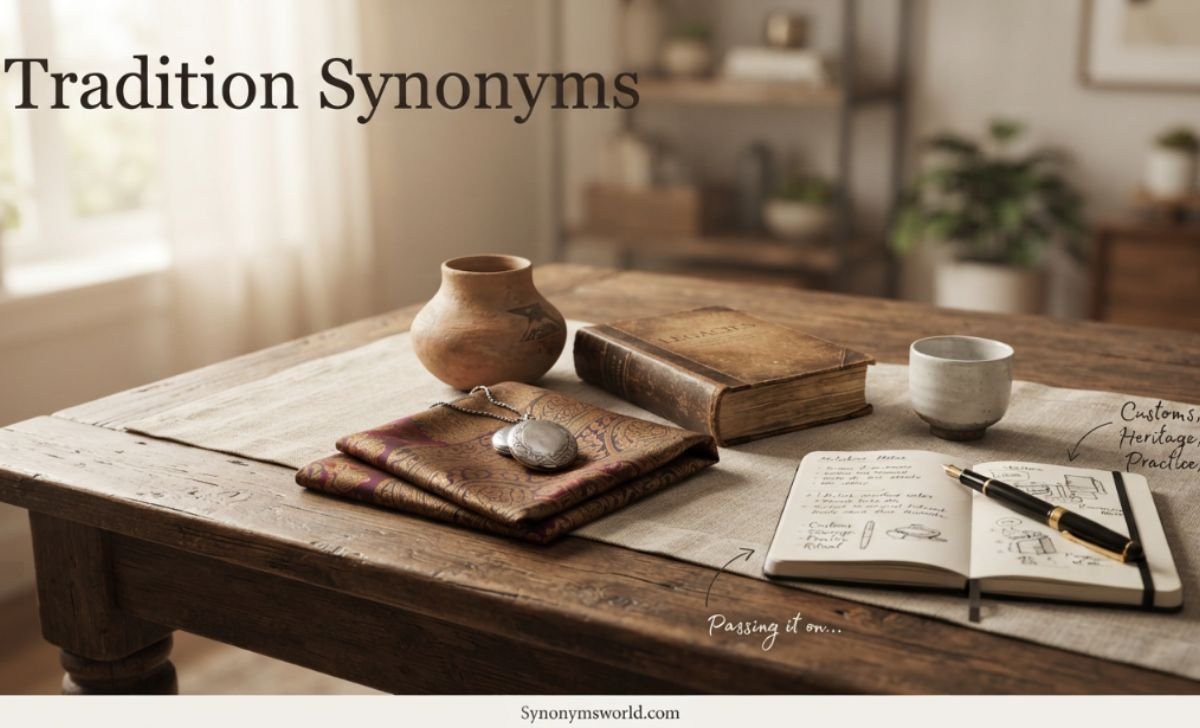
Have you ever used the word tradition several times in the same paragraph? It can make your writing feel repetitive. A simple synonym can make the sentence sound more natural.
Tradition means a custom, belief, or way of doing something that people follow for a long time. It is often passed from one generation to another.
For example, having a special meal together every Sunday can be a family tradition.
Learning tradition synonyms gives you more ways to talk about customs, culture, family habits, old practices, and shared beliefs.
Students can use them in essays, while bloggers and content writers can make their work more varied. Daily English users can also choose a word that fits the exact situation.
Below, you will find 50 useful words and phrases related to tradition, along with simple meanings and natural examples.
Custom
Meaning: A custom is a usual way of behaving or doing something in a group.
Examples:
- It is a family custom to eat dinner together.
- Removing shoes is a common custom in some homes.
Practice
Meaning: A practice is a way of doing something that people regularly follow.
Examples:
- Giving gifts is a common holiday practice.
- The school has a practice of welcoming new students.
Convention
Meaning: A convention is an accepted way of doing something.
Examples:
- The writer followed the usual convention.
- Formal dress is a convention at the event.
Heritage
Meaning: Heritage is the culture, history, and customs passed down from the past.
Examples:
- The festival celebrates our cultural heritage.
- She is proud of her family heritage.
Ritual
Meaning: A ritual is a repeated action that has a special meaning.
Examples:
- Reading together became their bedtime ritual.
- The ceremony includes an ancient ritual.
Observance
Meaning: Observance is the act of following or honoring a custom or special day.
Examples:
- The holiday includes a religious observance.
- The town held an observance for the occasion.
Habit
Meaning: A habit is something people do often or regularly.
Examples:
- Sunday lunch became a family habit.
- Reading before bed is an old habit in our house.
Legacy
Meaning: A legacy is something valuable passed from one generation to another.
Examples:
- The festival is part of the town’s legacy.
- Her kindness became a lasting family legacy.
Culture
Meaning: Culture is the shared way of life, beliefs, customs, and values of a group.
Examples:
- Food is an important part of their culture.
- Music plays a big role in local culture.
Folklore
Meaning: Folklore is the traditional stories, beliefs, and customs of a people.
Examples:
- The legend comes from local folklore.
- The museum displays objects linked to regional folklore.
Lore
Meaning: Lore is traditional knowledge, stories, or beliefs passed down over time.
Examples:
- The village is rich in local lore.
- Ancient lore still shapes the story.
Legend
Meaning: A legend is a traditional story that has been passed down for many years.
Examples:
- The mountain has an old legend.
- My grandfather told us a local legend.
Myth
Meaning: A myth is a traditional story connected with beliefs or cultural ideas.
Examples:
- The book explains an ancient myth.
- The myth has survived for generations.
Story
Meaning: A story can be an account passed from one generation to another.
Examples:
- My grandmother told us the family story.
- That story became part of our local history.
Tale
Meaning: A tale is a story that is often passed down over time.
Examples:
- The children enjoyed the old tale.
- This tale has been shared for generations.
Mythology
Meaning: Mythology is a collection of traditional myths from a culture.
Examples:
- Greek mythology has many famous stories.
- The class studied Norse mythology.
Mores
Meaning: Mores are the accepted customs and moral habits of a society.
Examples:
- Social mores change with time.
- The novel reflects the mores of its era.
Norm
Meaning: A norm is a behavior that a group accepts as normal.
Examples:
- Greeting guests is a social norm.
- The old norm is changing.
Rule
Meaning: A rule is an accepted guide for how people should act.
Examples:
- Eating together is an old family rule.
- The group follows a simple rule during the ceremony.
Principle
Meaning: A principle is a basic belief that guides actions.
Examples:
- Respect is an important family principle.
- The group continues to follow this principle.
Value
Meaning: A value is a belief about what is important or right.
Examples:
- Respect for elders is a shared value.
- The tradition reflects their cultural values.
Ethic
Meaning: An ethic is a belief about proper or responsible behavior.
Examples:
- Hard work is part of their family ethic.
- The practice reflects a strong community ethic.
Standard
Meaning: A standard is an accepted way or level of doing something.
Examples:
- The company kept its old standard.
- This standard has been followed for years.
Usage
Meaning: Usage is a customary way in which something is used or done.
Examples:
- The spelling follows traditional usage.
- Local usage differs from modern English.
Institution
Meaning: An institution can be an established custom or practice that has lasted for a long time.
Examples:
- The annual dinner became a community institution.
- The festival is now a local institution.
Inheritance
Meaning: Inheritance can refer to customs, beliefs, or practices received from earlier generations.
Examples:
- The recipe is part of her cultural inheritance.
- Music was an important inheritance from his grandparents.
Birthright
Meaning: A birthright is something viewed as an inherited right or possession.
Examples:
- They saw the land as their birthright.
- The language was treated as a cultural birthright.
Established Practice
Meaning: An established practice is a way of doing something that has been accepted for a long time.
Examples:
- The annual meeting is an established practice.
- Thanking guests is an established practice.
Customary Practice
Meaning: A customary practice is an action that a group normally follows.
Examples:
- Sharing food is a customary practice.
- The ceremony follows a customary practice.
Traditional Practice
Meaning: A traditional practice is an activity or method passed down through generations.
Examples:
- Hand weaving is a traditional practice.
- The school teaches a traditional practice of local art.
Long-Standing Practice
Meaning: A long-standing practice is something people have followed for many years.
Examples:
- The parade is a long-standing practice.
- Giving awards is a long-standing practice at the event.
Time-Honored Custom
Meaning: A time-honored custom is an old practice that people respect and continue.
Examples:
- The ceremony follows a time-honored custom.
- Cooking together is a time-honored custom.
Age-Old Custom
Meaning: An age-old custom is a very old practice that has survived for many years.
Examples:
- The village protects its age-old customs.
- The festival follows an age-old custom.
Ancestral Practice
Meaning: An ancestral practice is a custom inherited from earlier family members or ancestors.
Examples:
- They continue an ancestral practice of planting trees.
- The ceremony honors an ancestral practice.
Cultural Practice
Meaning: A cultural practice is an activity or custom shared by a particular culture.
Examples:
- Storytelling is an important cultural practice.
- The museum explains this cultural practice.
Social Custom
Meaning: A social custom is a behavior commonly accepted by a society or group.
Examples:
- Greeting visitors is an important social custom.
- Social customs vary between countries.
Family Custom
Meaning: A family custom is a practice followed by members of a family.
Examples:
- Baking together is our favorite family custom.
- Their family custom began with their grandparents.
Community Practice
Meaning: A community practice is an activity regularly followed by people in a local group.
Examples:
- The event began as a community practice.
- Sharing meals is a valued community practice.
Cultural Heritage
Meaning: Cultural heritage includes customs, beliefs, art, and practices passed down through time.
Examples:
- The dance is part of the country’s cultural heritage.
- The museum protects local cultural heritage.
Family Legacy
Meaning: A family legacy is something important passed from one generation to another.
Examples:
- The recipe is part of our family legacy.
- Teaching music became his family legacy.
Oral Tradition
Meaning: Oral tradition is knowledge or stories passed by speaking rather than writing.
Examples:
- The story survived through oral tradition.
- Many legends began as oral traditions.
Customary Way
Meaning: A customary way is the usual method of doing something.
Examples:
- They greeted visitors in the customary way.
- The meal was prepared in the customary way.
Established Convention
Meaning: An established convention is a commonly accepted method used for a long time.
Examples:
- The ceremony follows an established convention.
- The writer used an established convention.
Time-Honored Tradition
Meaning: A time-honored tradition is a respected practice that has continued for many years.
Examples:
- The race is a time-honored tradition.
- Making the cake is a time-honored tradition.
Age-Old Tradition
Meaning: An age-old tradition is a very old practice passed through generations.
Examples:
- The village protects its age-old tradition.
- The festival follows an age-old tradition.
Generational Practice
Meaning: A generational practice is something passed from one generation to another.
Examples:
- The recipe is a generational practice.
- Farming remains a generational practice there.
Cultural Continuity
Meaning: Cultural continuity means keeping customs and beliefs alive across generations.
Examples:
- Language helps maintain cultural continuity.
- The festival supports cultural continuity.
Traditionalism
Meaning: Traditionalism is a strong preference for older customs and established ways.
Examples:
- Traditionalism shapes many local celebrations.
- His traditionalism is clear in family events.
Tradition Synonyms by Context
A synonym is not always a perfect replacement. The right word depends on what you mean.
A family tradition, good choices include family custom, family practice, family ritual, family legacy, and generational practice.
For a cultural tradition, consider cultural practice, cultural heritage, cultural legacy, cultural continuity, and social custom.
A traditional practice, useful alternatives include custom, established practice, customary practice, long-standing practice, and ancestral practice.
When you mean traditional stories or beliefs, folklore, lore, legend, myth, tale, and oral tradition are often more precise.
This is why simply replacing tradition with any word from a synonym list can sometimes change the meaning.
Tradition Synonyms and Antonyms
Some words are close to tradition, while others express an opposite or contrasting idea.
Common antonyms of tradition include:
- Innovation
- Novelty
- Change
- Modernity
- Originality
- Experimentation
- Reform
- Nonconformity
- New idea
- New approach
For example:
The company moved away from tradition and embraced innovation.
Here, innovation creates a clear contrast with an established way of doing something.
Another Word for Traditional Practice
If you need another word for traditional practice, the best options are:
- Custom
- Established practice
- Customary practice
- Cultural practice
- Long-standing practice
- Ancestral practice
- Age-old custom
- Time-honored custom
- Social custom
- Generational practice
Custom is usually the simplest choice. Ancestral practice highlights a connection with ancestors, while cultural practice focuses on a particular culture.
Family Tradition Synonyms
A family tradition is something a family regularly does or passes down through generations.
Natural alternatives include:
- Family custom
- Family practice
- Family ritual
- Family legacy
- Generational practice
- Ancestral practice
- Family heritage
- Long-standing family custom
For example:
Sunday dinner is a family tradition.
You could also say:
Sunday dinner is a long-standing family custom.
The second sentence focuses more on the custom itself.
Cultural Tradition Synonyms
A cultural tradition is a custom, belief, activity, or practice connected with a culture.
Useful alternatives include:
- Cultural practice
- Cultural custom
- Cultural heritage
- Cultural legacy
- Cultural continuity
- Community tradition
- Social custom
- Ancestral practice
- Folk tradition
- Oral tradition
For example:
Traditional dance is part of the community’s cultural heritage.
Here, cultural heritage works well because the sentence focuses on something preserved and passed down.
Tradition in a Sentence
Here are some natural examples of the word tradition:
- Baking cookies is a Christmas tradition in our family.
- The festival is an important local tradition.
- They have a tradition of helping new neighbors.
- The school has a long tradition of academic success.
- We decided to continue the tradition this year.
- The ceremony follows an old tradition.
What Is the Part of Speech of Tradition?
Tradition is a noun.
It can describe one particular custom:
This is a family tradition.
It can also describe the general idea of following old customs:
They respect tradition.
The adjective form is traditional.
For example:
They prepared a traditional meal.
The adverb is traditionally:
The festival is traditionally held in spring.
Tradition vs. Custom
Tradition and custom are very close, but there can be a small difference.
A custom is a usual way of behaving or doing something within a group. A tradition often carries the idea of something being passed down or continued over time.
For example:
Removing shoes before entering a home can be a custom.
But:
Celebrating the same holiday meal every year can be a family tradition.
The two words can overlap, so context matters.
Tradition vs. Culture
Culture is much broader than tradition.
Culture can include:
- Language
- Food
- Music
- Art
- Values
- Beliefs
- Customs
- Traditions
- Social behavior
A tradition is usually one part of a culture.
For example:
A cultural tradition may be one practice within a much larger culture.
Tradition vs. Ritual
A ritual is usually a repeated action with a special meaning. A tradition has a wider meaning.
For example:
Lighting candles before dinner is a family ritual.
But:
Celebrating a yearly family reunion is a family tradition.
A tradition can include a ritual, but the two words are not always interchangeable.
Tradition vs. Heritage
Heritage focuses on what is inherited from the past. Tradition often focuses on a practice, belief, or custom that people continue to follow.
For example:
Traditional music is part of our cultural heritage.
Both words work together because they describe related ideas from slightly different angles.
How to Choose the Best Synonym for Tradition
Start by asking what you want the word to describe.
Custom when you mean a usual behavior.
Practice for a regular way of doing something.
Hritage when you mean something inherited from the past.
Ritual for a repeated action with special meaning.
Legacy for something valuable passed to future generations.
Folklore, lore, legend, or myth when talking about traditional stories or beliefs.
Family custom for a practice followed within a family.
Cultural practice when discussing the customs of a particular culture.
Choosing a synonym based on meaning makes your writing clearer and more natural than simply picking the first word in a thesaurus.
FAQs
1. What is the best synonym for tradition?
Custom is one of the closest everyday synonyms for tradition. Depending on context, practice, convention, heritage, ritual, and legacy can also work.
2. What is another word for traditional practice?
Custom, established practice, customary practice, cultural practice, long-standing practice, and ancestral practice are useful alternatives.
3. What is a synonym for family tradition?
Common choices include family custom, family practice, family ritual, family legacy, and generational practice.
4. What is a synonym for cultural tradition?
Useful alternatives include cultural practice, cultural custom, cultural heritage, cultural legacy, and cultural continuity.
5. What are the antonyms of tradition?
Common contrasting words include innovation, novelty, change, modernity, originality, experimentation, and nonconformity.
6. Is tradition a noun or adjective?
Tradition is a noun. Its adjective form is traditional.
7. What is the adjective form of tradition?
The adjective is traditional. It means connected with or based on established customs or practices.
8. Can custom and tradition be used interchangeably?
Sometimes, yes. Both can describe an accepted way of doing something, but tradition often stresses that the practice has continued or been passed down over time.
9. Can heritage be a synonym for tradition?
Sometimes. Heritage focuses more on what is inherited from the past, while tradition often focuses on customs, beliefs, or practices that continue.
10. What are some formal synonyms for tradition?
Depending on the context, formal alternatives include established practice, convention, customary practice, cultural heritage, ancestral practice, and cultural continuity.
Conclusion
Learning tradition synonyms gives you more choices when writing or speaking. Words such as custom, practice, heritage, ritual, convention, legacy, and cultural practice can help you express your exact meaning.
The best synonym depends on context. Practice these words in essays, emails, blog posts, and daily conversations.
With regular use, your vocabulary becomes more flexible, your writing sounds less repetitive, and your communication becomes clearer.