Do you use the word “but” too often in your writing? This small word helps connect different ideas, show contrast, and point out exceptions.
However, repeating it in every paragraph can make your writing sound less varied. Learning alternatives can help you express the same idea in a more natural way.
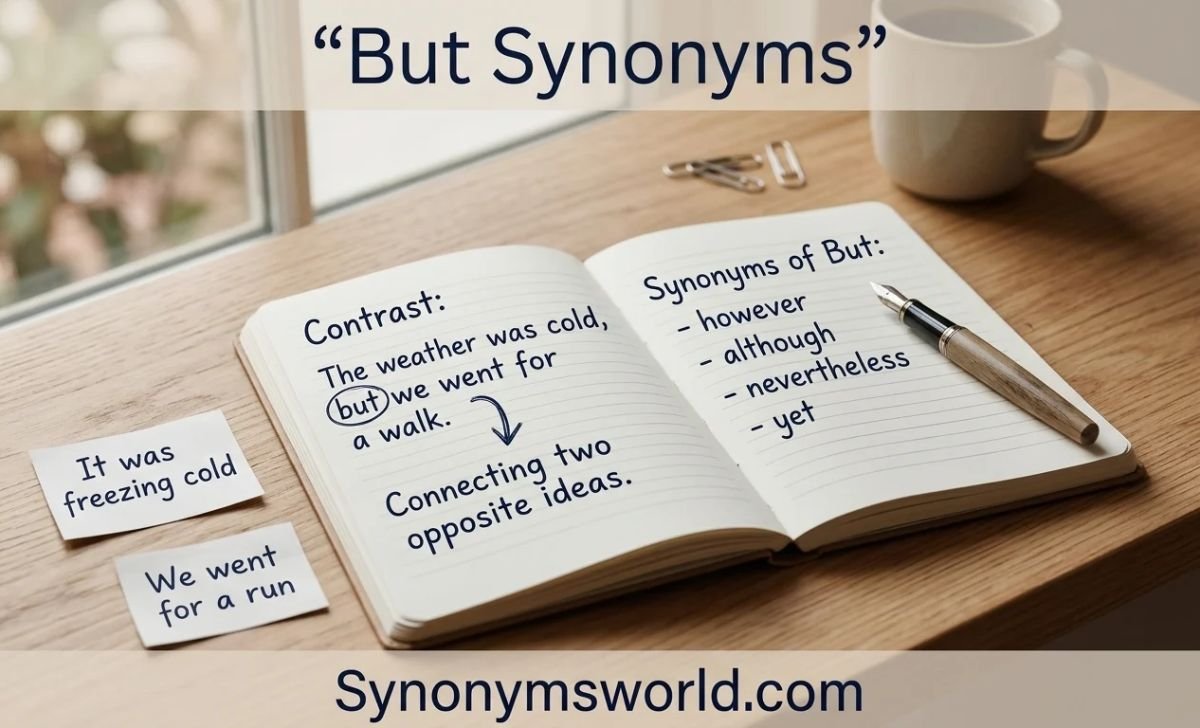
For example, “I was tired, but I finished my work” can become “I was tired, yet I finished my work.” You can also write, “I was tired. However, I finished my work.”
Both versions show contrast, but the grammar is different. This guide covers 50 useful synonyms and related alternatives for but, with simple meanings and examples for students, bloggers, professionals, and everyday English users.
Quick Answer
Common synonyms and alternatives for but include however, yet, although, though, nevertheless, nonetheless, still, whereas, even so, and despite that. These expressions help show contrast, although some require a different sentence structure.
When but means “except,” you can use except, except for, or other than. When it means “only,” alternatives include only, just, and merely.
Examples:
- I wanted to go, but I was busy.
- I wanted to go. However, I was busy.
- Everyone came but Sam. → Everyone came except Sam.
The right alternative depends on the meaning of but and the grammar of your sentence.
What Does But Mean?
The word but has three main uses.
Contrast: It connects ideas that differ or seem unexpected.
Example: She was tired, but she continued working.
Exception: It means “except” when someone or something is excluded.
Example: Everyone came but Jack.
Only: In formal or literary English, but can mean “only” or “merely.”
Example: He is but a child.
These meanings matter because a contrast word cannot always replace but when it means “except” or “only.”
50 Synonyms and Alternatives for But
The following words and expressions are grouped by their main use. Some are direct alternatives for contrast, while others work only for particular meanings of but. The examples show how each expression fits into a sentence.
1. However
Meaning: Introduces a contrasting statement, often in a new sentence.
Example: The hotel was expensive. However, the service was excellent.
2. Yet
Meaning: Connects two contrasting ideas, often with a surprising result.
Example: The task was difficult, yet Mia completed it on time.
3. Although
Meaning: Introduces a fact that contrasts with the main statement.
Example: Although it was raining, we played outside.
4. Though
Meaning: Means “although” and is common in everyday English.
Example: Though the room was small, it felt comfortable.
5. Nevertheless
Meaning: Shows that something happens despite a difficulty or opposing fact.
Example: The road was icy. Nevertheless, the rescue team continued.
6. Nonetheless
Meaning: Means “in spite of that” and introduces a contrasting result.
Example: He had little experience. Nonetheless, he handled the job well.
7. Still
Meaning: Introduces a contrasting point or shows that a situation remains true.
Example: The journey was tiring. Still, we enjoyed it.
8. Even So
Meaning: Shows that a result remains true despite the previous fact.
Example: The shop was closing. Even so, the owner served us.
9. All the Same
Meaning: Means “despite that” and shows that a fact does not change the outcome.
Example: We disagreed. All the same, we remained friends.
10. On the Other Hand
Meaning: Presents a different side of an issue or comparison.
Example: The apartment is small. On the other hand, it is close to work.
11. In Contrast
Meaning: Highlights a difference between two things or situations.
Example: The north is cold in winter. In contrast, the south stays mild.
12. Conversely
Meaning: Introduces an opposite or reversed situation.
Example: Higher prices may reduce demand. Conversely, lower prices may attract more buyers.
13. Whereas
Meaning: Connects two clauses to show a difference between them.
Example: My brother enjoys football, whereas I prefer tennis.
14. While
Meaning: Can introduce a contrasting fact or situation.
Example: While I enjoy city life, my parents prefer the countryside.
15. Even Though
Meaning: Introduces a fact that makes the main result seem unexpected.
Example: Even though he was tired, he finished the report.
16. Despite This
Meaning: Shows that something happens even though the previous fact might prevent it.
Example: The team had little funding. Despite this, it completed the project.
17. Despite That
Meaning: Means “in spite of that fact.”
Example: The forecast looked poor. Despite that, we went hiking.
18. In Spite of This
Meaning: Introduces a result that occurs despite a stated difficulty.
Example: The room was noisy. In spite of this, I managed to study.
19. That Said
Meaning: Introduces a qualification or a different point about an earlier statement.
Example: The course is expensive. That said, the lessons are useful.
20. Be That as It May
Meaning: A formal expression meaning “even if that is true.”
Example: Be that as it may, we must follow the safety rules.
21. Except
Meaning: Excludes a person or thing from a group.
Example: Everyone attended except Omar.
22. Except for
Meaning: Identifies something that is excluded or differs from the rest.
Example: Except for one spelling error, the essay was excellent.
23. Apart from
Meaning: Means “excluding” when identifying an exception.
Example: Apart from Lina, everyone submitted the form.
24. Aside from
Meaning: Can identify an exception or, in some contexts, introduce an additional point.
Example: Aside from two spelling errors, the essay was excellent.
25. Other than
Meaning: Means “except for” or “different from.”
Example: No one other than the owner had the key.
26. Excluding
Meaning: Leaves someone or something out of a group or total.
Example: The trip costs $200, excluding meals.
27. Barring
Meaning: Means “unless something prevents it” or “except for.”
Example: Barring any delays, the train should arrive at noon.
28. Save
Meaning: Means “except for” in formal or literary English.
Example: The garden was empty save for a single bird.
29. With the Exception Of
Meaning: Identifies a person or thing that is not included.
Example: With the exception of Nina, all the players arrived early.
30. Not Including
Meaning: Indicates that something is excluded from a total or group.
Example: The bill is $45, not including tax.
31. Excepting
Meaning: Means “excluding,” although except is more common in everyday English.
Example: Excepting two late arrivals, the group was ready on time.
32. Only
Meaning: Means “only” or “merely” when but expresses limitation.
Example: He is but a child. → He is only a child.
33. Just
Meaning: Can mean “only” when describing a limited amount or status.
Example: She is but a beginner. → She is just a beginner.
34. Merely
Meaning: Means “only” and can suggest that something is limited in importance or scope.
Example: It was merely a suggestion, not an order.
35. Simply
Meaning: Can mean “just” or “only” in a suitable context.
Example: It was simply a misunderstanding.
36. Solely
Meaning: Means “only” or “exclusively.”
Example: The decision was based solely on cost.
37. Nothing But
Meaning: Means “only” or “nothing other than.”
Example: The box contained nothing but old letters.
38. No More Than
Meaning: Means “only as much as” or “not exceeding.”
Example: The walk took no more than ten minutes.
39. But For
Meaning: Means “if it were not for” and describes a condition that changes an outcome.
Example: But for your help, I would have missed the deadline.
40. Minus
Meaning: Means that an amount has been taken away.
Example: The final price was $80, minus the discount.
41. On the Contrary
Meaning: Rejects or corrects an earlier statement by presenting the opposite.
Example: I am not upset. On the contrary, I am glad you told me.
42. For All That
Meaning: Means “despite everything” and is more common in formal or literary writing.
Example: He had many faults. For all that, his friends trusted him.
43. Notwithstanding
Meaning: Means “despite” and is mainly used in formal or legal writing.
Example: Notwithstanding the delay, the project was completed on time.
44. Howbeit
Meaning: Means “however” or “nevertheless,” but it is rare and old-fashioned.
Example: The task was difficult, howbeit possible.
45. Though That May Be
Meaning: A formal expression that acknowledges a fact before introducing a contrasting point.
Example: The plan is costly, though that may be, we should consider its benefits.
46. Even If
Meaning: Introduces a possible condition that will not change the main decision or result.
Example: Even if it rains, we will attend the event.
47. Despite
Meaning: Means “in spite of” and introduces a noun or noun phrase rather than a full clause.
Example: Despite the rain, we continued the match.
48. Regardless Of
Meaning: Shows that something is not affected by a particular factor.
Example: We will continue regardless of the weather.
49. Instead
Meaning: Introduces a different action or choice rather than a direct contrast.
Example: We did not take a taxi. Instead, we walked home.
50. Rather
Meaning: Can introduce a correction or alternative, especially in the phrase “but rather.”
Example: It was not a failure, but rather a lesson.
Formal Alternatives to But
In professional emails, reports, and academic writing, however, nevertheless, although, and whereas are useful when their meanings fit. Choose the expression that makes the relationship between your ideas clear.
Examples:
- The proposal is costly. However, it may save money in the long term.
- Although the deadline was short, the team completed the report.
A formal word is not automatically better than a simple one. Accuracy and clarity matter more.
Informal Alternatives to But
In everyday English, though, yet, and still can express contrast naturally. You can also keep but when it communicates your meaning best.
Examples:
- The food was good, though a little salty.
- I was tired, but I still visited my friend.
Synonyms for But in IELTS Writing
IELTS writing requires clear ideas, accurate grammar, and suitable vocabulary. Although, however, whereas, and nevertheless can help you express contrast without repeating the same sentence pattern.
Examples:
- Although public transport can be crowded, it may reduce traffic.
- City life offers more jobs. However, housing can be expensive.
Do not use rare expressions just to sound advanced. Correct grammar and natural vocabulary are more useful.
Alternatives to But at the Start of a Sentence
Starting a sentence with but is acceptable in modern English. You can also begin with however, still, or even so when the meaning fits.
Examples:
- The shop was closed. However, the café next door was open.
- I knew the journey would be difficult. Even so, I wanted to try.
When however links contrasting statements, use suitable punctuation, such as a period or a semicolon before it and a comma after it.
What Does “I Am But a Beginner” Mean?
In this phrase, but means “only” or “merely,” not “however.”
Examples:
- I am but a beginner. → I am only a beginner.
- He is but one person. → He is just one person.
This use is more common in literary or formal English than in everyday conversation.
But vs. However, Although, Though, and Yet
| Word | Main use | Example |
|---|---|---|
| But | Joins contrasting clauses | I called, but no one answered. |
| However | Introduces a contrasting statement | I called. However, no one answered. |
| Although | Introduces a dependent clause | Although I called, no one answered. |
| Though | Similar to although | Though I called, no one answered. |
| Yet | Joins contrasting clauses | I called, yet no one answered. |
These words express related ideas but do not always follow the same grammar pattern.
Common Mistakes When Replacing But
1. Confusing contrast with exception
However introduces contrast, while except excludes someone or something. They are not interchangeable.
2. Using incorrect punctuation
Incorrect: The room was small, however, it was comfortable.
Correct: The room was small. However, it was comfortable.
3. Using although and but together unnecessarily
Incorrect: Although it was late, but we continued.
Correct: Although it was late, we continued.
4. Choosing rare words for ordinary writing
Howbeit and notwithstanding can sound unnatural in casual messages. Use them only when their tone fits.
5. Replacing every but
There is no need to change but when it already expresses your idea clearly.
What Are the Antonyms of But?
The word but has no single direct antonym because its meaning changes with context. When it expresses contrast, and can connect ideas through addition instead, but it is not a true antonym.
Examples:
- Contrast: I wanted to go, but I stayed home.
- Addition: I wanted to go, and I stayed for dinner.
Choose words according to the relationship between your ideas rather than memorizing one opposite word.
FAQs
1. What is the most common synonym for but?
However is a common alternative when introducing a contrasting statement. For example, “The task was hard. However, we finished it.”
2. What is a formal word for but?
However, nevertheless, and nonetheless are useful formal alternatives for expressing contrast. Although works when introducing a dependent clause.
3. What can I use instead of but at the start of a sentence?
You can use however, still, or even so when the meaning fits. Starting a sentence with but is also acceptable.
4. What are synonyms for but in IELTS writing?
Useful choices include although, however, whereas, and nevertheless. Use each word with correct grammar and punctuation.
5. Is however always a synonym for but?
No. However can express contrast, but it usually introduces a contrasting statement rather than joining two clauses in the same way as but.
6. What is an informal alternative to but?
Though is a natural choice in many everyday sentences. For example, “I liked the meal, though it was salty.”
7. Can I start a sentence with but?
Yes. It is acceptable in modern English when the connection with the previous sentence is clear.
8. What does but mean in “I am but a beginner”?
Here, but means “only” or “merely.” The sentence means “I am only a beginner.”
9. Does but have an antonym?
No single word is a direct antonym in every context. The appropriate alternative depends on whether but expresses contrast, exception, or limitation.
10. What is the difference between but and although?
But joins contrasting clauses, while although introduces a dependent clause. For example, “I was tired, but I continued” and “Although I was tired, I continued.”
Conclusion
Synonyms and alternatives for but can make your writing clearer when you choose them according to their meaning.
Words such as however, yet, and although express contrast, while except identifies exclusions and only expresses limitation.
These alternatives do not all work in the same sentence structure, so check the grammar before replacing a word.
Whether you write essays, emails, blog posts, or everyday messages, clear and natural language matters more than using a different word every time.
Read More Blogs: