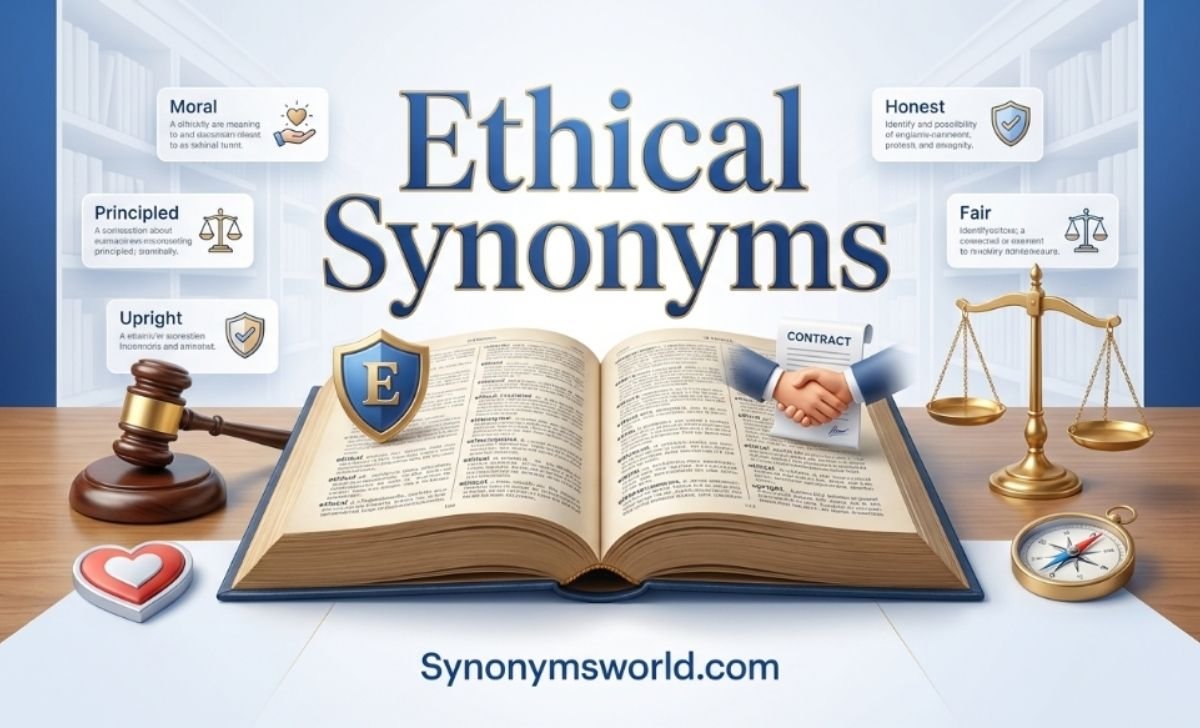
Have you ever needed another word for ethical in an essay, email, or work report? You may know what you want to say, but using the same word again and again can make your writing feel dull.
The word ethical usually describes something that follows accepted ideas of right and wrong. For example, an ethical business treats its workers fairly and does not lie to customers.
Learning ethical synonyms gives you more ways to talk about good behavior, fair choices, honesty, and strong values.
These words can help students write better essays, bloggers avoid repetition, content writers choose the right tone, and daily English users speak more clearly.
Some alternatives are very close to ethical, while others fit only certain situations. The list below helps you understand the difference.
Moral
Meaning: Moral means following ideas about what is right and wrong.
Examples:
- She made a moral choice.
- The story teaches a moral lesson.
Principled
Meaning: Principled means guided by strong beliefs about what is right.
Examples:
- He is a principled leader.
- She stayed principled under pressure.
Righteous
Meaning: Righteous means strongly believing that your actions are right and good.
Examples:
- The hero fought for a righteous cause.
- He felt righteous about his decision.
Virtuous
Meaning: Virtuous means having very good moral qualities.
Examples:
- She was known as a virtuous person.
- The novel presents him as virtuous.
Honorable
Meaning: Honorable means deserving respect because of good and fair behavior.
Examples:
- He made an honorable choice.
- She kept her promise in an honorable way.
Honest
Meaning: Honest means telling the truth and not trying to deceive people.
Examples:
- Please give me an honest answer.
- His honest reply helped us decide.
Fair
Meaning: Fair means treating people equally and reasonably.
Examples:
- The manager made a fair decision.
- Everyone deserves a fair chance.
Just
Meaning: Just means fair and right, especially when people are treated equally.
Examples:
- The judge made a just decision.
- They wanted a just solution.
Upright
Meaning: Upright describes a person who behaves in an honest and moral way.
Examples:
- Everyone trusted the upright teacher.
- He was an upright and respected man.
Good
Meaning: Good can describe actions or choices that are right and helpful.
Examples:
- She made a good choice.
- It was good of him to help.
Decent
Meaning: Decent means behaving in a proper, honest, and respectful way.
Examples:
- He is a decent person.
- She gave the workers decent treatment.
Respectable
Meaning: Respectable means worthy of respect because of good behavior.
Examples:
- They run a respectable business.
- He has a respectable reputation.
Trustworthy
Meaning: Trustworthy means someone can be trusted to do what is right or keep promises.
Examples:
- We need a trustworthy partner.
- She is honest and trustworthy.
Reliable
Meaning: Reliable means someone or something can be trusted to act as expected.
Examples:
- We found a reliable supplier.
- He is reliable at work.
Responsible
Meaning: Responsible means taking care to do what is right and deal with the results of your actions.
Examples:
- Responsible companies protect customer data.
- She is a responsible team leader.
Accountable
Meaning: Accountable means being responsible for your actions and decisions.
Examples:
- Leaders must be accountable for their choices.
- The company held its manager accountable.
Lawful
Meaning: Lawful means allowed by law.
Examples:
- The company followed a lawful process.
- They wanted a lawful way to solve the problem.
Legal
Meaning: Legal means permitted by the law.
Examples:
- The business uses legal methods.
- Is this practice legal?
Legitimate
Meaning: Legitimate means valid, proper, or accepted as lawful.
Examples:
- The customer had a legitimate concern.
- They found a legitimate way to solve it.
Proper
Meaning: Proper means suitable, correct, and acceptable in a situation.
Examples:
- Use proper methods when collecting data.
- The team followed the proper process.
Appropriate
Meaning: Appropriate means suitable and right for a particular situation.
Examples:
- That was an appropriate response.
- We need an appropriate way to handle the issue.
Respectful
Meaning: Respectful means showing care and respect for other people.
Examples:
- Keep your message respectful.
- She gave a respectful reply.
Considerate
Meaning: Considerate means thinking about other people’s feelings and needs.
Examples:
- He was considerate of his coworkers.
- A considerate driver gives others space.
Compassionate
Meaning: Compassionate means showing care for people who are suffering or need help.
Examples:
- The doctor gave compassionate care.
- She took a compassionate approach.
Humane
Meaning: Humane means treating people or animals with kindness and care.
Examples:
- The shelter follows humane practices.
- Workers deserve humane treatment.
Benevolent
Meaning: Benevolent means kind and willing to help others.
Examples:
- A benevolent donor helped the school.
- The group supports benevolent causes.
Altruistic
Meaning: Altruistic means caring about other people’s well-being without seeking personal gain.
Examples:
- Her altruistic actions inspired others.
- He made an altruistic donation.
Selfless
Meaning: Selfless means putting other people’s needs before your own.
Examples:
- Her selfless work helped many families.
- He made a selfless decision.
Conscientious
Meaning: Conscientious means careful about doing your duties correctly and responsibly.
Examples:
- She is a conscientious employee.
- He took a conscientious approach to the task.
Sincere
Meaning: Sincere means honest and genuine in what you say or feel.
Examples:
- She gave a sincere apology.
- His sincere words changed my mind.
Genuine
Meaning: Genuine means real, honest, and not fake.
Examples:
- He showed genuine concern.
- The company made a genuine effort to help.
Candid
Meaning: Candid means open and honest, even when the truth may be difficult.
Examples:
- She gave a candid opinion.
- His candid answer surprised everyone.
Transparent
Meaning: Transparent means open and clear about actions, decisions, or information.
Examples:
- The company has a transparent policy.
- We need a transparent hiring process.
Open
Meaning: Open can describe someone who communicates honestly and does not hide important information.
Examples:
- The manager was open about the problem.
- We had an open discussion.
Truthful
Meaning: Truthful means telling the truth and avoiding lies.
Examples:
- Please be truthful about what happened.
- Her truthful answer cleared up the issue.
Trusting
Meaning: Trusting means willing to believe that another person is honest or good.
Examples:
- He was too trusting of strangers.
- Her trusting nature made her easy to work with.
Clean
Meaning: Clean can describe behavior or business practices that are honest and free from wrongdoing.
Examples:
- The company has a clean record.
- They wanted a clean and fair deal.
Aboveboard
Meaning: Aboveboard means completely honest, legal, and open.
Examples:
- The deal was completely aboveboard.
- We keep all our business dealings aboveboard.
Straightforward
Meaning: Straightforward means honest, clear, and without hidden aims.
Examples:
- He gave a straightforward answer.
- The company uses a straightforward policy.
Fair-minded
Meaning: Fair-minded means willing to judge people and situations in a fair way.
Examples:
- Our teacher is fair-minded.
- A fair-minded leader listens to both sides.
Even-handed
Meaning: Even-handed means treating different people or sides equally.
Examples:
- The editor gave an even-handed review.
- We need an even-handed approach.
Impartial
Meaning: Impartial means not favoring one person or side over another.
Examples:
- The referee remained impartial.
- An impartial review can help readers.
Unbiased
Meaning: Unbiased means free from unfair personal preferences.
Examples:
- We need an unbiased opinion.
- The report gives an unbiased view.
Neutral
Meaning: Neutral means not supporting one side in a disagreement or decision.
Examples:
- The mediator stayed neutral.
- Try to use neutral language in the report.
Equitable
Meaning: Equitable means fair and reasonable for everyone involved.
Examples:
- They wanted an equitable agreement.
- The policy aims for equitable treatment.
Principled-minded
Meaning: Principled-minded describes someone who tries to act according to strong moral values.
Examples:
- She is a principled-minded professional.
- He took a principled-minded position.
High-minded
Meaning: High-minded describes ideas or actions based on strong moral standards.
Examples:
- He supported a high-minded goal.
- Her high-minded approach impressed the team.
Conforming to moral standards
Meaning: This phrase describes behavior that follows accepted ideas of right and wrong.
Examples:
- The study follows standards for conforming to moral standards.
- Their policy focuses on conforming to moral standards.
Morally sound
Meaning: Morally sound means based on a strong and acceptable sense of right and wrong.
Examples:
- The plan seems morally sound.
- We need a morally sound solution.
Ethically responsible
Meaning: Ethically responsible means taking care to make choices that respect people and accepted moral standards.
Examples:
- Companies should be ethically responsible.
- The team chose an ethically responsible approach.
Value-based
Meaning: Value-based means guided by important beliefs or principles.
Examples:
- They use a value-based approach.
- The program supports value-based decisions.
Socially responsible
Meaning: Socially responsible means acting in ways that consider the effect on people and society.
Examples:
- The brand promotes socially responsible business.
- Consumers often support socially responsible companies.
How to Choose the Right Ethical Synonym
Not every word above can replace ethical in every sentence. The best choice depends on what you mean.
Moral when you are talking about right and wrong.
Principled when you want to show that someone follows strong beliefs.
Honest, truthful, or sincere when the main idea is honesty.
Fair, just, equitable, impartial, or unbiased when the focus is equal treatment.
Lawful or legal when you mean something is allowed by law. However, remember that legal and ethical are not always the same. Something can be legal but still raise ethical concerns.
Responsible or accountable when you are talking about duties and the results of decisions.
Tumane, compassionate, or considerate when kindness and care are the main ideas.
Transparent when you want to stress openness and clear information.
Ethical vs Moral: Are They the Same?
Ethical and moral are very close in meaning, but they are not always used in exactly the same way.
Moral often relates to personal or shared beliefs about right and wrong.
Ethical is often used when discussing standards, rules, professional behavior, organizations, or decisions.
For example:
- She has strong moral values.
- The company follows ethical standards.
Both words can describe good behavior, but the context can make one sound more natural than the other.
Ethical vs Legal
Ethical and legal should not be treated as exact synonyms.
Legal means something is allowed by law. Ethical means something follows accepted ideas of right and wrong.
For example, a business practice may be legal but still be seen as unfair or harmful. In that case, people may question its ethics even though no law has been broken.
This difference is useful in business writing, law-related discussions, journalism, and academic essays.
Ethical Values and Their Synonyms
When people talk about ethical values, they often mean ideas such as:
- Honesty
- Fairness
- Respect
- Responsibility
- Integrity
- Trust
- Justice
- Compassion
- Accountability
- Transparency
These values can guide personal choices, workplace behavior, research, communication, and business decisions.
A good synonym for ethical values depends on the sentence. Moral values, principles, standards, and guiding principles can often work well.
Synonyms for Ethical Behavior
If you are looking for another way to say ethical behavior, useful choices include:
- Moral behavior
- Principled behavior
- Responsible behavior
- Honest conduct
- Responsible conduct
- Good conduct
- Upright behavior
- Fair conduct
- Respectful conduct
- Lawful conduct
The best option depends on the exact point you want to make. For example, honest conduct focuses on truth, while fair conduct focuses on equal treatment.
Synonyms for Ethical Issues
The phrase ethical issues refers to questions or problems involving right and wrong.
Possible alternatives include:
- Moral questions
- Moral concerns
- Ethical concerns
- Questions of right and wrong
- Moral problems
- Matters of ethics
- Value-based concerns
- Questions of fairness
For academic writing, ethical concerns and moral questions are often useful alternatives.
Synonyms for Ethical Communication
Ethical communication means communicating honestly, fairly, respectfully, and responsibly.
Related terms include:
- Honest communication
- Responsible communication
- Respectful communication
- Transparent communication
- Fair communication
- Open communication
- Truthful communication
- Sincere communication
For example, a writer should avoid false claims and misleading information when communicating with an audience.
Synonyms for Ethical Use
Ethical use means using something in a responsible and morally acceptable way.
Depending on the context, you can use:
- Responsible use
- Proper use
- Appropriate use
- Fair use
- Lawful use
- Safe use
- Responsible practice
- Appropriate practice
The exact replacement depends on what is being used and what standard you are discussing.
Antonyms of Ethical
The most direct opposite of ethical is unethical.
Other words can express different forms of unethical behavior:
- Immoral
- Dishonest
- Unfair
- Corrupt
- Deceptive
- Unprincipled
- Wrong
- Improper
- Irresponsible
- Unlawful
These words are not all exact opposites in every sentence. For example, unlawful means against the law, while unethical means morally wrong or unacceptable. The distinction matters.
Ethical in a Sentence
Here are some natural examples:
- The company follows ethical business practices.
- She made an ethical decision.
- Ethical behavior builds trust.
- The researchers followed ethical standards.
- We should use ethical methods when collecting information.
These examples show how ethical works with words such as decision, behavior, standards, methods, and practices.
Common Mistakes With Ethical Synonyms
One common mistake is treating every related word as a perfect replacement.
For example, legal does not always mean ethical. A legal action can still be viewed as unfair.
Another mistake is using honest when the sentence is really about fairness. Honesty means telling the truth, while fairness means treating people equally.
Likewise, moral and ethical are close, but their use can depend on context.
The safest approach is to choose a synonym based on the exact idea you want to express.
FAQs
1. What are 5 good synonyms for ethical?
Five strong choices are moral, principled, virtuous, honorable, and righteous. However, the best word depends on the sentence and context.
2. What is the best synonym for ethical?
Moral is one of the closest general synonyms for ethical. Principled is also a strong choice when describing a person, decision, or action guided by firm values.
3. What is the opposite of ethical?
The most direct opposite is unethical. Other related opposites include immoral, dishonest, unfair, corrupt, and unprincipled.
4. Is ethical the same as moral?
They are very similar, but they can have different uses. Moral often refers to beliefs about right and wrong, while ethical is common when discussing standards, conduct, professions, and decisions.
5. What does ethical mean in simple words?
Ethical means doing what is considered right, fair, and honest.
6. What are the synonyms of ethics?
Depending on context, related terms include morality, principles, values, standards, beliefs, conduct, and code of conduct.
7. What is a synonym for ethical values?
Moral values is the closest common alternative. Other choices include principles, moral principles, guiding values, and standards.
8. What is another word for ethical behavior?
You can use moral behavior, principled behavior, responsible behavior, honest conduct, or upright behavior, depending on the meaning.
9. What is an ethical issue?
An ethical issue is a question or problem about what is right, wrong, fair, or responsible.
10. What is the difference between ethical and unethical?
Ethical describes behavior that follows accepted moral standards. Unethical describes behavior that goes against those standards.
Conclusion
Learning ethical synonyms gives you more ways to express ideas about honesty, fairness, responsibility, and good behavior.
Words such as moral, principled, fair, honorable, responsible, and trustworthy can make your writing more precise.
However, do not replace ethical with a random synonym. Choose a word that matches your exact meaning.
Practice these alternatives in emails, essays, blog posts, workplace writing, and daily conversations. With regular practice, your vocabulary will become clearer, stronger, and more natural.
Read More Blogs: