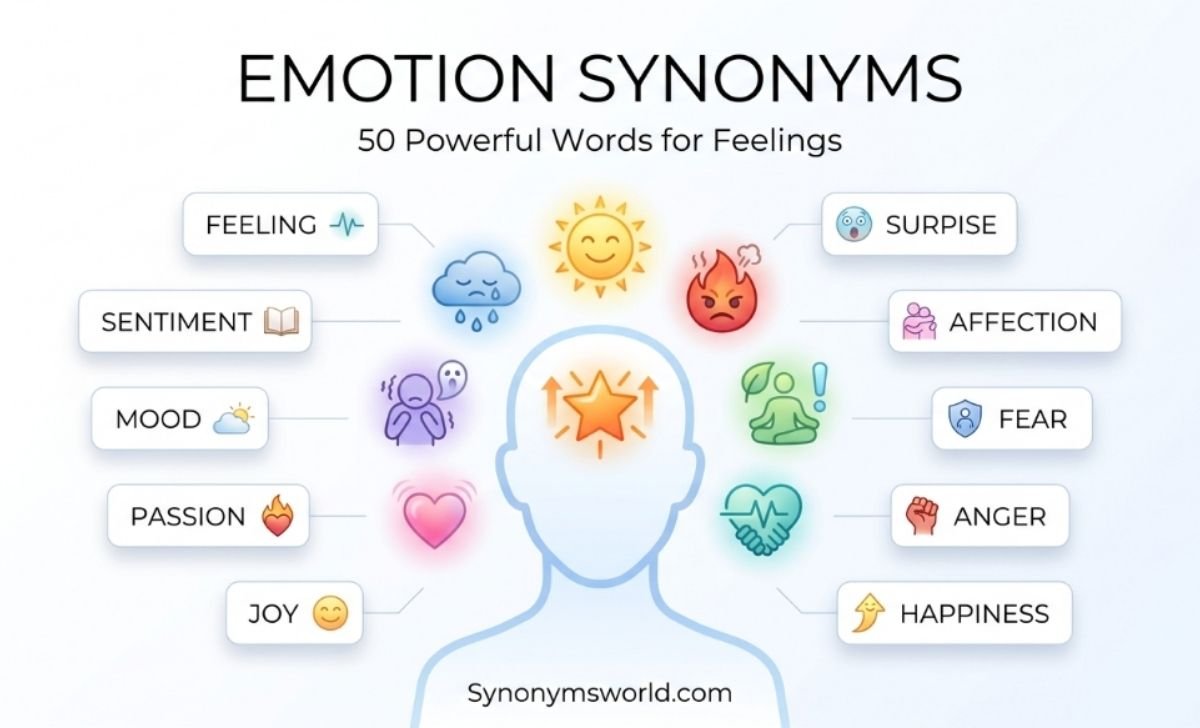
Have you ever used the word emotion too many times in your writing? Maybe you want to describe happiness, sadness, anger, love, or fear in a more exact way. That is where emotion synonyms can help.
An emotion is a feeling or reaction that a person experiences. For example, happiness is an emotion, while fear is another.
However, not every synonym has exactly the same meaning. Words such as feeling, sentiment, mood, and passion work in different situations.
Learning different words for emotions can make your writing more natural and expressive. It can help students write better essays, bloggers avoid repetition, content writers create stronger descriptions, and daily English users communicate their thoughts clearly.
This guide explores 50 useful emotion synonyms, with simple meanings and real-life examples.
Quick Answer
Common synonyms for emotion include feeling, sentiment, mood, passion, affection, reaction, response, sensation, excitement, and feeling state.
The best word depends on the situation. Feeling is the most general choice, while sentiment often describes an attitude or opinion.
Passion suggests a very strong feeling, and mood usually describes a longer-lasting emotional state.
Feeling
Meaning: A feeling is an emotion or personal reaction that you experience.
Examples:
- I have a happy feeling today.
- She shared her feelings with me.
Sentiment
Meaning: Sentiment is a feeling or attitude toward someone or something.
Examples:
- The letter showed strong sentiment.
- Public sentiment changed after the news.
Mood
Meaning: A mood is the way a person feels at a particular time.
Examples:
- He was in a cheerful mood.
- The music changed my mood.
Passion
Meaning: Passion is a very strong feeling about someone or something.
Examples:
- She has a passion for music.
- His passion for the sport is clear.
Affection
Meaning: Affection is a warm feeling of love or care.
Examples:
- The child showed affection for her dog.
- He has great affection for his grandmother.
Reaction
Meaning: A reaction is an emotional response to something that happens.
Examples:
- Her reaction surprised everyone.
- His first reaction was fear.
Response
Meaning: A response is the way someone reacts to an event or situation.
Examples:
- Her emotional response was understandable.
- He gave a calm response.
Sensation
Meaning: A sensation is a feeling that you notice in your mind or body.
Examples:
- I felt a strange sensation.
- The song created a warm sensation.
Excitement
Meaning: Excitement is a strong feeling of happiness and energy.
Examples:
- The children shouted with excitement.
- I felt excitement before the trip.
Love
Meaning: Love is a deep feeling of care, affection, or attachment.
Examples:
- Her love for her family is strong.
- He expressed his love through kind words.
Joy
Meaning: Joy is a strong feeling of great happiness.
Examples:
- The news filled her with joy.
- His face showed pure joy.
Happiness
Meaning: Happiness is the feeling of being pleased or satisfied.
Examples:
- Family brings her happiness.
- He smiled with happiness.
Sadness
Meaning: Sadness is the feeling you have when something makes you unhappy.
Examples:
- She felt sadness after the goodbye.
- His voice showed deep sadness.
Anger
Meaning: Anger is a strong feeling caused by something unfair, wrong, or upsetting.
Examples:
- He could not hide his anger.
- Her anger faded after the talk.
Fear
Meaning: Fear is the feeling you have when you believe something may hurt or harm you.
Examples:
- The loud noise caused fear.
- She faced her fear bravely.
Anxiety
Meaning: Anxiety is a feeling of worry, fear, or unease.
Examples:
- He felt anxiety before the test.
- Her anxiety grew as the time passed.
Delight
Meaning: Delight is a strong feeling of happiness or pleasure.
Examples:
- The gift filled her with delight.
- She smiled with delight.
Pleasure
Meaning: Pleasure is a feeling of enjoyment or happiness.
Examples:
- Reading gives me great pleasure.
- He took pleasure in helping others.
Desire
Meaning: Desire is a strong feeling of wanting something.
Examples:
- She had a strong desire to travel.
- His desire for success kept him working.
Hope
Meaning: Hope is a positive feeling that something good may happen.
Examples:
- We still have hope.
- Her words gave me hope.
Gratitude
Meaning: Gratitude is the feeling of being thankful.
Examples:
- He expressed gratitude for the help.
- I feel deep gratitude toward my teacher.
Empathy
Meaning: Empathy is the ability to understand and share another person’s feelings.
Examples:
- She showed empathy toward her friend.
- Good leaders need empathy.
Sympathy
Meaning: Sympathy is a feeling of care for someone who is having a hard time.
Examples:
- We offered sympathy after the loss.
- She showed sympathy for her neighbor.
Compassion
Meaning: Compassion is a strong wish to help someone who is suffering.
Examples:
- The nurse treated everyone with compassion.
- His compassion touched the whole team.
Admiration
Meaning: Admiration is a strong feeling of respect or approval.
Examples:
- I have great admiration for her work.
- His courage earned their admiration.
Appreciation
Meaning: Appreciation is a feeling of thanks or respect for someone or something.
Examples:
- She showed appreciation for the gift.
- His work deserves appreciation.
Disappointment
Meaning: Disappointment is sadness caused by something not being as good as expected.
Examples:
- Missing the train was a disappointment.
- He could not hide his disappointment.
Frustration
Meaning: Frustration is an annoyed feeling caused by a problem or delay.
Examples:
- The long wait caused frustration.
- She spoke out of frustration.
Irritation
Meaning: Irritation is a feeling of slight anger or annoyance.
Examples:
- His constant noise caused irritation.
- She showed irritation during the meeting.
Resentment
Meaning: Resentment is a lasting feeling of anger about unfair treatment.
Examples:
- He still felt resentment toward his former boss.
- Resentment can damage relationships.
Regret
Meaning: Regret is sadness about something you did or failed to do.
Examples:
- She felt regret after the argument.
- He expressed regret for his words.
Guilt
Meaning: Guilt is a bad feeling caused by believing you did something wrong.
Examples:
- He felt guilt after lying.
- Her guilt was easy to notice.
Shame
Meaning: Shame is a painful feeling caused by doing something wrong or embarrassing.
Examples:
- He felt shame after his mistake.
- She tried to hide her shame.
Pride
Meaning: Pride is a feeling of pleasure in your own or someone else’s success.
Examples:
- Her parents felt pride in her success.
- He smiled with pride.
Jealousy
Meaning: Jealousy is an unhappy feeling caused by fear of losing someone’s attention or advantage.
Examples:
- Jealousy affected their friendship.
- He felt jealousy when his friend won.
Envy
Meaning: Envy is an unhappy feeling because someone else has something you want.
Examples:
- She felt envy toward her successful coworker.
- Envy can make people unhappy.
Surprise
Meaning: Surprise is the feeling caused by something unexpected.
Examples:
- The gift brought surprise and joy.
- His face showed surprise.
Wonder
Meaning: Wonder is a feeling of surprise mixed with curiosity or admiration.
Examples:
- The child looked at the stars with wonder.
- I watched the show in wonder.
Awe
Meaning: Awe is a powerful feeling of wonder and respect.
Examples:
- The view filled us with awe.
- She stood in awe of the huge mountain.
Curiosity
Meaning: Curiosity is a strong desire to know or learn something.
Examples:
- His curiosity led him to ask questions.
- She opened the box out of curiosity.
Concern
Meaning: Concern is a feeling of worry about someone or something.
Examples:
- Her health was a major concern.
- He showed concern for his friend.
Worry
Meaning: Worry is an uneasy feeling about a possible problem.
Examples:
- Money was his biggest worry.
- She could not hide her worry.
Calmness
Meaning: Calmness is a peaceful and relaxed emotional state.
Examples:
- Her calmness helped the team.
- Meditation gave him a sense of calmness.
Serenity
Meaning: Serenity is a deep feeling of peace and quiet.
Examples:
- The garden gave her a sense of serenity.
- He enjoyed the serenity of the lake.
Contentment
Meaning: Contentment is a peaceful feeling of being satisfied with what you have.
Examples:
- He found contentment in simple things.
- Her quiet life brought contentment.
Enthusiasm
Meaning: Enthusiasm is a strong feeling of excitement and interest.
Examples:
- She showed enthusiasm for the new project.
- His enthusiasm encouraged the team.
Eagerness
Meaning: Eagerness is a strong feeling of wanting to do or get something.
Examples:
- The students showed eagerness to learn.
- He waited with eagerness.
Affliction
Meaning: Affliction is a state of emotional or physical suffering.
Examples:
- The loss caused great emotional affliction.
- She spoke about her years of affliction.
Distress
Meaning: Distress is a strong feeling of sadness, worry, or pain.
Examples:
- The news caused great distress.
- She called for help in distress.
Melancholy
Meaning: Melancholy is a quiet and deep feeling of sadness.
Examples:
- The old song created a sense of melancholy.
- His face had a melancholy look.
Sentience
Meaning: Sentience refers to the ability to experience feelings or sensations.
Examples:
- The discussion focused on animal sentience.
- Sentience is linked to the ability to experience sensations.
How to Choose the Right Emotion Word
Not every synonym works in every sentence. The right choice depends on the type and strength of the feeling.
For a general emotional experience, feeling is usually the safest word. If you are describing an attitude toward an issue, sentiment may fit better. For a temporary emotional condition, mood is useful.
Stronger feelings, words such as passion, distress, awe, enthusiasm, and desire add more intensity. For positive emotions, joy, delight, gratitude, appreciation, and contentment work well.
This is especially useful in essays, blogs, stories, emails, and everyday conversations because the exact word can make your message clearer.
Emotion Synonyms for Positive Feelings
If you need different words for positive emotions, consider:
- Joy
- Happiness
- Delight
- Pleasure
- Hope
- Gratitude
- Appreciation
- Love
- Affection
- Enthusiasm
- Contentment
- Serenity
- Pride
- Admiration
These words help you describe positive feelings without repeating happy or good.
Words for Deep or Powerful Emotions
When you want to describe deep emotions or powerful emotions, these words can be useful:
- Passion
- Love
- Grief
- Awe
- Devotion
- Distress
- Despair
- Resentment
- Compassion
- Admiration
- Longing
- Anguish
The choice depends on whether the emotion is positive, negative, calm, or intense.
Emotion Synonyms and Antonyms
There is no single perfect antonym for emotion because the opposite depends on what aspect of emotion you mean.
Words that can suggest emotional distance or lack of feeling include:
- Indifference
- Apathy
- Detachment
- Unconcern
- Impassivity
For example, apathy means a lack of interest or feeling, while indifference suggests that something does not matter much to a person.
Emotion vs. Feeling vs. Sentiment
These words are close, but they are not always interchangeable.
Emotion is a broad term for a strong mental or physical response.
Feeling is a general word for what you experience inside.
Sentiment often refers to an attitude or feeling toward a person, idea, or situation.
For example, you might say, “I have a strong feeling about this,” while a news report might discuss “public sentiment.”
Why Better Emotion Words Matter
Strong vocabulary does more than make writing sound fancy. It helps you express exactly what you mean.
Compare these two sentences:
“She had an emotion after hearing the news.”
This is vague.
“She felt deep sadness after hearing the news.”
The second sentence tells the reader much more.
This is why emotion vocabulary matters for students, bloggers, writers, teachers, and anyone who wants to communicate clearly. In Psychology, terms such as emotional response, emotional state, emotional awareness, and emotional regulation also help describe different parts of human emotional experience.
FAQs
1. What’s a fancy word for emotion?
Sentiment, passion, affection, and sensation can sound more specific or polished than the general word emotion. The best choice depends on the context.
2. What are 10 words that are related to emotions?
Ten common emotion-related words are feeling, sentiment, mood, passion, affection, joy, sadness, anger, fear, and excitement.
3. What words can I use instead of feelings?
You can use emotions, sentiments, reactions, sensations, moods, or responses, depending on the meaning of your sentence.
4. What are some synonyms for “emotionally”?
Depending on the context, you can use phrases such as in an emotional way, with feeling, passionately, personally, or sentimentally.
5. What is a synonym for expressing emotion?
Useful alternatives include showing feelings, conveying emotion, revealing feelings, expressing feelings, and displaying emotion.
6. What’s another word for deep emotion?
Words such as passion, intensity, affection, devotion, longing, anguish, and deep feeling can describe a powerful or deeply felt emotion.
7. What is a word for positive emotions?
Joy, happiness, delight, gratitude, hope, love, appreciation, enthusiasm, and contentment are common words for positive emotions.
8. What are some synonyms for powerful emotions?
Depending on the feeling, you can use intense feelings, strong emotions, passion, excitement, awe, distress, anguish, or overwhelming feelings.
9. What’s a word for strong emotions?
Intensity describes the strength of an emotion, while passion, excitement, anger, love, or awe can describe specific strong emotions.
10. What’s a nicer word for emotional?
Depending on your meaning, sensitive, expressive, compassionate, passionate, heartfelt, or deeply feeling may sound more positive than simply calling someone emotional.
Conclusion
Learning emotion synonyms gives you more ways to describe what people think and feel. Words such as feeling, sentiment, mood, passion, joy, and affection each add a slightly different meaning.
Using the right word can make your essays, blog posts, emails, stories, and daily conversations clearer and more natural.
Instead of repeating emotion or feelings, choose a word that shows the exact type or strength of the experience.
Practice these words in simple sentences. Over time, you will build a stronger vocabulary and become more confident when expressing emotions in English.
Read More Blogs: