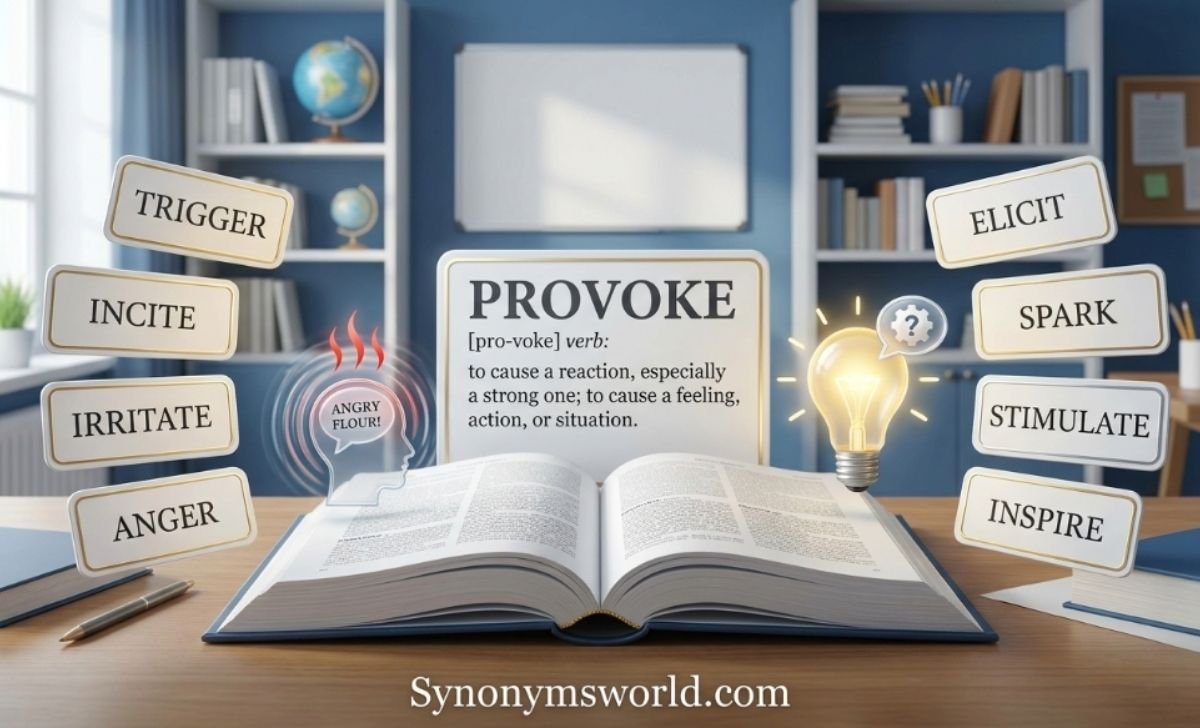
Have you ever said something that made someone react strongly? Maybe your words made a friend angry, started a debate, or caused everyone to laugh. In each case, you may use the word provoke.
But what if you want a more exact word? That is where provoke synonyms can help. Words such as trigger, irritate, incite, elicit, spark, and stimulate can describe different kinds of reactions.
The word provoke means to cause a reaction, feeling, or action. It can have a negative meaning, such as making someone angry. It can also be neutral or positive, such as causing thought or discussion.
Learning provoke synonyms is useful for students, bloggers, content writers, and anyone who wants clearer English. The right synonym can make your writing sound more natural and precise.
Trigger
Meaning: To trigger means to cause something to start or happen.
Examples:
- The news triggered a public debate.
- His comment triggered a strong reaction.
Incite
Meaning: To incite means to encourage people to take strong or angry action.
Examples:
- The speech incited the crowd.
- His words incited anger among the workers.
Instigate
Meaning: To instigate means to start an argument, conflict, or other event.
Examples:
- Jake instigated the argument.
- She was accused of instigating the dispute.
Elicit
Meaning: To elicit means to get a response, feeling, or answer from someone.
Examples:
- The question elicited a quick reply.
- Her joke elicited a loud laugh.
Stimulate
Meaning: To stimulate means to encourage interest, activity, or thought.
Examples:
- The book stimulated my interest in science.
- The lesson stimulated a lively discussion.
Prompt
Meaning: To prompt means to cause someone to say or do something.
Examples:
- The message prompted me to call.
- Her question prompted a useful idea.
Evoke
Meaning: To evoke means to bring a feeling, memory, or image to mind.
Examples:
- The song evoked childhood memories.
- The old house evoked a sense of peace.
Arouse
Meaning: To arouse means to cause a strong feeling, interest, or reaction.
Examples:
- The story aroused my curiosity.
- The report aroused public concern.
Rouse
Meaning: To rouse means to make someone feel excited, angry, or ready to act.
Examples:
- The coach roused the tired players.
- Her speech roused the audience.
Goad
Meaning: To goad means to deliberately push someone into reacting.
Examples:
- He kept trying to goad me.
- She goaded him into an argument.
Antagonize
Meaning: To antagonize means to make someone angry or unfriendly.
Examples:
- His rude attitude antagonized his coworkers.
- Do not antagonize the customer.
Agitate
Meaning: To agitate means to make someone worried, upset, or angry.
Examples:
- The unfair decision agitated the workers.
- Loud sounds can agitate some people.
Irritate
Meaning: To irritate means to annoy or bother someone.
Examples:
- The buzzing sound irritated me.
- His repeated questions irritated the teacher.
Annoy
Meaning: To annoy means to make someone slightly angry or bothered.
Examples:
- Please stop annoying your sister.
- The long wait annoyed the customers.
Anger
Meaning: To anger someone means to make that person feel angry.
Examples:
- The unfair rule angered the students.
- His remarks angered many people.
Enrage
Meaning: To enrage means to make someone extremely angry.
Examples:
- The false claim enraged him.
- The decision enraged local residents.
Infuriate
Meaning: To infuriate means to make someone very angry.
Examples:
- His careless behavior infuriated his boss.
- The unfair treatment infuriated the players.
Exasperate
Meaning: To exasperate means to make someone very annoyed or frustrated.
Examples:
- The delays exasperated the travelers.
- Her constant excuses exasperated me.
Frustrate
Meaning: To frustrate means to make someone upset because something does not go as planned.
Examples:
- The computer problem frustrated him.
- The slow service frustrated the guests.
Upset
Meaning: To upset means to make someone unhappy, worried, or angry.
Examples:
- The bad news upset her.
- His sudden decision upset the team.
Disturb
Meaning: To disturb means to interrupt someone’s peace or make them worried.
Examples:
- The report disturbed many readers.
- The strange message disturbed him.
Trouble
Meaning: To trouble someone means to cause worry or concern.
Examples:
- The strange noise troubled the family.
- The news troubled many parents.
Aggravate
Meaning: To aggravate means to make a problem or angry feeling worse.
Examples:
- His words aggravated the situation.
- Do not aggravate the conflict.
Inflame
Meaning: To inflame means to make anger or conflict stronger.
Examples:
- The speech inflamed public anger.
- His comments inflamed the debate.
Fuel
Meaning: To fuel means to make a feeling, problem, or conflict grow stronger.
Examples:
- The rumor fueled public fear.
- His actions fueled the argument.
Stir
Meaning: To stir means to cause a feeling, reaction, or interest.
Examples:
- The movie stirred strong emotions.
- Her story stirred my imagination.
Awaken
Meaning: To awaken means to cause a feeling, memory, or interest to become active.
Examples:
- The trip awakened her love of art.
- The book awakened old memories.
Inspire
Meaning: To inspire means to make someone feel motivated or excited to do something.
Examples:
- Her story inspired me to study.
- The teacher inspired a love of reading.
Encourage
Meaning: To encourage means to give someone support or a reason to act.
Examples:
- My parents encouraged me to try.
- The coach encouraged the young players.
Motivate
Meaning: To motivate means to give someone a reason or desire to act.
Examples:
- The reward motivated the students.
- His success motivated me to continue.
Drive
Meaning: To drive someone means to cause them to act or feel strongly.
Examples:
- Curiosity drove her to investigate.
- The deadline drove him to work faster.
Move
Meaning: To move someone means to cause a strong emotional response.
Examples:
- Her speech moved the audience.
- The story moved everyone deeply.
Affect
Meaning: To affect means to cause a change in someone’s feelings, thoughts, or actions.
Examples:
- The news affected him deeply.
- Stress can affect your mood.
Influence
Meaning: To influence means to affect how someone thinks, feels, or acts.
Examples:
- Friends can influence our choices.
- The teacher influenced my career choice.
Induce
Meaning: To induce means to cause a particular state, feeling, or action.
Examples:
- The medicine induced sleep.
- The speech induced a feeling of hope.
Cause
Meaning: To cause means to make something happen.
Examples:
- The mistake caused confusion.
- His joke caused a strong reaction.
Produce
Meaning: To produce means to cause a result or response.
Examples:
- The announcement produced excitement.
- Her answer produced a strange reaction.
Generate
Meaning: To generate means to create or cause something to happen.
Examples:
- The question generated a debate.
- The campaign generated public interest.
Create
Meaning: To create means to cause something new to happen or exist.
Examples:
- His comment created tension.
- The idea created a lot of interest.
Bring About
Meaning: To bring about means to cause something to happen.
Examples:
- The new rule brought about major changes.
- Her actions brought about a strong response.
Set Off
Meaning: To set off means to cause a reaction or event to begin.
Examples:
- The alarm set off a panic.
- His comment set off an argument.
Spark
Meaning: To spark means to start a feeling, idea, discussion, or event.
Examples:
- The article sparked a debate.
- Her question sparked my interest.
Pique
Meaning: To pique means to make someone curious or interested.
Examples:
- The headline piqued my curiosity.
- The mystery piqued her interest.
Challenge
Meaning: To challenge means to question or test someone in a way that may cause a response.
Examples:
- The reporter challenged his claim.
- Her question challenged my thinking.
Provoke
Meaning: To provoke means to cause a reaction, feeling, action, or response.
Examples:
- His joke provoked laughter.
- The comment provoked anger.
Prod
Meaning: To prod means to push or urge someone to take action.
Examples:
- My friend prodded me to apply.
- The teacher prodded him to finish.
Push
Meaning: To push someone means to encourage or pressure them to react or act.
Examples:
- Do not push him into an argument.
- The deadline pushed me to work harder.
Needle
Meaning: To needle someone means to annoy them on purpose.
Examples:
- His brother kept needling him.
- She was needling me about my mistake.
Tease
Meaning: To tease means to make fun of someone in a playful or annoying way.
Examples:
- The children teased their friend.
- She likes to tease her brother.
Bait
Meaning: To bait means to deliberately try to make someone react.
Examples:
- He was trying to bait me into an argument.
- Do not take the bait when someone insults you.
How to Choose the Best Synonym for Provoke
The best alternative depends on the kind of reaction you mean.
Trigger, cause, prompt, elicit, or produce when something causes a reaction or result.
Irritate, annoy, anger, enrage, infuriate, antagonize, or agitate when someone becomes upset or angry.
Incite, instigate, inflame, fuel, spark, or set off when something starts conflict, debate, or strong action.
Inspire, stimulate, evoke, awaken, motivate, or pique for positive or neutral reactions involving ideas, interest, feelings, or curiosity.
Goad, needle, prod, or bait when someone deliberately tries to make another person react.
Provoke Synonyms for Anger
When provoke means “make someone angry,” the strongest choices include anger, irritate, antagonize, agitate, aggravate, enrage, and infuriate.
They do not all show the same level of anger. Irritate usually suggests mild annoyance, while enrage and infuriate suggest very strong anger.
For example:
- The noise irritated me.
- The unfair decision enraged the workers.
Positive Synonyms for Provoke
The word provoke does not always describe something negative. A question can provoke thought, a story can provoke emotion, and an article can provoke discussion.
For positive or neutral situations, stimulate, inspire, evoke, awaken, pique, prompt, and spark are often better choices.
For example:
- The book stimulated my interest in history.
- Her question sparked an interesting discussion.
Provoke vs. Incite
Provoke is a broad word. It can mean causing anger, laughter, thought, interest, or another response.
Incite is more specific. It usually means encouraging people to take strong action, especially angry or harmful action.
Compare these sentences:
- The joke provoked laughter.
- The speech incited the crowd.
So, incite cannot replace provoke in every sentence.
Provoke vs. Instigate
Provoke means to cause a reaction. Instigate usually means to start something, especially an argument, conflict, or problem.
- His comment provoked anger.
- His comment instigated an argument.
The second sentence focuses on starting the argument.
Provoke vs. Irritate
Irritate means to annoy or bother someone. Provoke has a wider meaning.
- The noise irritated me.
- The question provoked a strong response.
If the main idea is annoyance, irritate is usually more exact.
Provoke vs. Trigger
Trigger and provoke can both mean to cause a reaction.
However, trigger often focuses on the event that starts something, while provoke can focus on the reaction itself.
- The news triggered a debate.
- His words provoked an angry response.
Is Provoke a Positive or Negative Word?
Provoke can be positive, negative, or neutral.
When it means making someone angry, it has a negative sense. When it means causing thought, curiosity, laughter, or discussion, it can be neutral or positive.
The context tells you which meaning is intended.
FAQs
1. What is the best synonym for provoke?
There is no single best synonym. Trigger, incite, elicit, irritate, stimulate, and prompt can work in different contexts.
2. What is another word for provoke someone?
You can use antagonize, irritate, anger, annoy, goad, needle, or bait, depending on the situation.
3. What is a synonym for provoke anger?
Common choices include anger, irritate, enrage, infuriate, aggravate, antagonize, and inflame.
4. Is trigger a synonym for provoke?
Yes. Trigger can replace provoke when both words mean causing a reaction or event to happen.
5. Is incite the same as provoke?
No. Incite usually means encouraging people to take strong action, while provoke has a much wider meaning.
6. What is the opposite of provoke?
Depending on the context, possible antonyms include calm, soothe, pacify, appease, prevent, and avoid.
7. What is a positive synonym for provoke?
Useful positive or neutral alternatives include inspire, stimulate, evoke, pique, awaken, and spark.
8. What are some slang synonyms for provoke?
In informal English, needle, bait, push, goad, and mess with can express the idea of trying to get a reaction. Some are very casual.
9. What is a five-letter synonym for provoke?
There is no single common five-letter synonym that matches every meaning of provoke. Prod is a useful four-letter alternative when the meaning is to push someone into action.
10. How do you use provoke in a sentence?
Use provoke when something causes a reaction or feeling. For example: “Her question provoked an interesting discussion.”
Conclusion
Learning provoke synonyms gives you more choices when you write or speak. Instead of using the same word again and again, you can choose a word that shows the exact meaning.
Use irritate for annoyance, incite for strong action, elicit for a response, and spark for a new idea or discussion.
Practice these words in emails, essays, blog posts, and daily conversations. Small vocabulary changes can make your English clearer and more natural.
Read More Blogs: